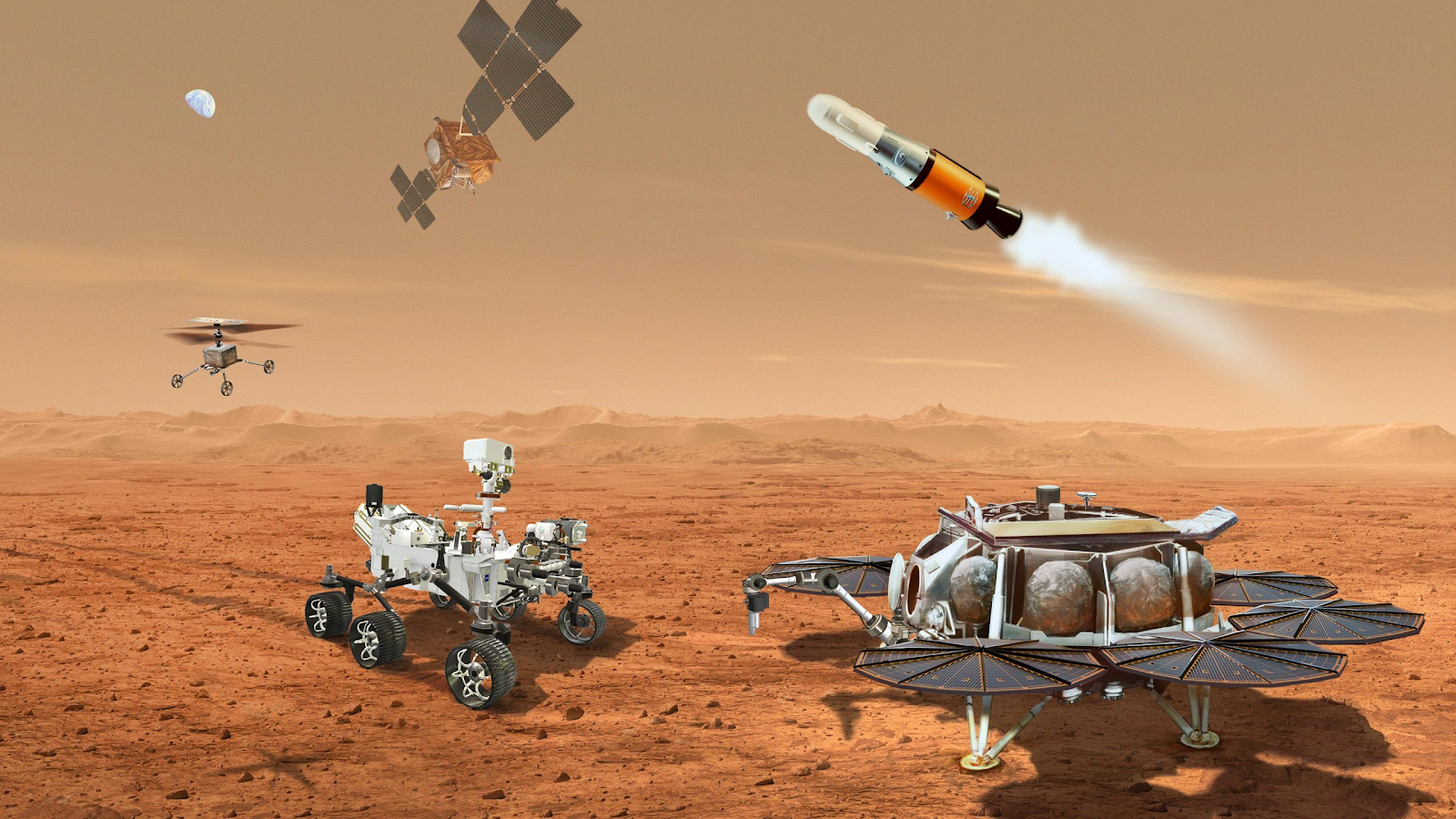
Image 1)" This illustration shows a concept for a set of future robots working together to ferry back samples from the surface of Mars collected by NASA’s Mars Perseverance rover. Credit: NASA/ESA/JPL-Caltech" (ScitechDaily/NASA Selects Lockheed Martin Space To Build Rocket To Retrieve First Samples From Mars)
Lockheed-Martin took the contract for creating a rocket that brings the first samples from Mars. That launch will be the first that brings samples from other planets. The purpose of the mission is also to collect data for the first manned Mars mission.
But that launch from another planet is same way remarkable as helicopter flight at Mars atmosphere. The rocket from Mars to Earth is the pathfinder for more difficult missions like bringing water samples from the icy moons of Jupiter.
When we think about missions in the distant future. Those missions focused on more distant objects and planets like Neptune. There is needed a new type of technology to make the mission successful.
Things like artificial intelligence are needed. To make the independently operating probes that can take the most interesting samples. The helicopter probes can mark places where their plasma spectrometers detect things like chlorophyll molecules. Or the independently operating helicopter can take samples from those points. The system that takes samples from Mars to Earth consists of three independent systems.
The helicopter, the Perseverance rover, along with other rovers, and of course, the rocket are tools for that system. That rocket sends samples to Earth. And it can be similar to MGM-51 Lance tactical missile from the past.
Image 2) MGM-52 Lance
And maybe some kind of laboratory vehicle where is more multi-use systems like scanning tunneling microscopes for pre-select samples that will load to rocket. Those samples are sent to Earth or Moon laboratories. That laboratory might connect to the launch platform of the rocket.
But that rocket must carry the fuel inside it for returning to Earth. Or it can use the electrolysis for breaking water on Mars. But that kind of system requires water. So the fuel and oxygen must load to rocket on Earth. The rocket itself can bases technology that is developed for tactical missiles like MGM-52 Lance or Pershing. The question is does that rocket use liquid or solid fuel.
The moon-based laboratories must not be manned. The remote control modules can involve similar systems with BL-5 level laboratories. But on the Moon, those samples are not polluted. The remote-control systems make those modules easy to operate from Earth.
Image 2)Daedalus spacecraft concept.
But of course, those samples can take to BL-5 laboratories that are needed to keep them sterile. If Earth bacteria infects those samples. They can cover or destroy the remains of life like Martian bacteria fossils.
The system that will travel to those distant planets is the probe that is controlled with highly sophisticated artificial intelligence. There might be man-looking robots onboard that are fixing errors and damages of those probes. The journey to Neptune takes a very long time and robot craft would not require that any person must stay years in the space.
The probe for outer planets might look like Daedalus-probe that planned to send to Alpha Centauri. But for technical reasons that famous theoretical study project remains as the papers and drawings. Maybe someday in the future, that kind of plan turns to real space systems. And maybe that day is closer than we even think. If ten years ago somebody would say. Someday NASA will get samples from Mars to Earth that thing would claim pure fantasy.
The system would be very independent. And it can select its samples itself. The capacity for independent operations is a key element for successful missions in Kuiper Belt. Those probes must select the target in seconds if they want to catch small asteroids that might be from other solar systems. After catching objects that seem interesting. The probe would put those asteroids in a cargo room and send them to Earth.
And that is the final training for interstellar probes. The interstellar space probe is the thing that travels tens of years to stars. The technology that those missions require is similar. To that the probes that operate at the Kuiper belt require.
https://scitechdaily.com/mars-ascent-vehicle-nasa-selects-lockheed-martin-space/
https://en.wikipedia.org/wiki/MGM-31_Pershing
https://en.wikipedia.org/wiki/MGM-52_Lance
https://en.wikipedia.org/wiki/Project_Daedalus
Image 1)https://scitechdaily.com/mars-ascent-vehicle-nasa-selects-lockheed-martin-space/
Image 2) https://en.wikipedia.org/wiki/MGM-52_Lance
Image 3)https://en.wikipedia.org/wiki/Project_Daedalus
https://thoughtandmachines.blogspot.com/