When we think about energy flow from the strongest to the weakest. Free energy. That causes an atom’s decay. It is formed. Or. Released in the atom’s core. The strong interaction releases the first energy impulse that can rip the atom into pieces.
When gluon send their radiation impulse into the shell of protons or neutrons.
That shell oscillates, sending the W boson. Then that boson causes the oscillation in the atom’s core. That is called the weak interaction. The electroweak interaction is the energy wave between electrons and the atom’s core. The energy flow between electrons and the atom’s core is much more complicated. Than. The energy flow. Between the atom’s core and the electron shell.
All structures in an atom send wave movement. Those structures include quarks and bosons. Along with bond strings between quarks. And bonds between protons and neutrons. They send. Wave movement at their own frequency. That frequency. It is the same.
As the size of those structures. If. We think that the particle, like a gluon. It is like a plate. This means that. The particle sends wave movements with two wavelengths.
The larger structure. Sends waves with a wavelength. That is the same as the particle’s cross section. Same way on the thinner side. It sends waves. That wavelength is the same.
As the thinner side cross-section.
This means. That. Dark energy may come from structures. That nobody has seen. Or that is the logical explanation for that energy flow. At this point, we must realize.
That any structure creates energy from nothing.
Material is denser energy. And all nuclear and electromagnetic reactions release energy that is stored in matter. The opposite version is that the structure binds energy into itself. This is wave-particle duality. Energy can turn into matter, and matter can turn into energy. Only in annihilation does matter turn completely into energy.
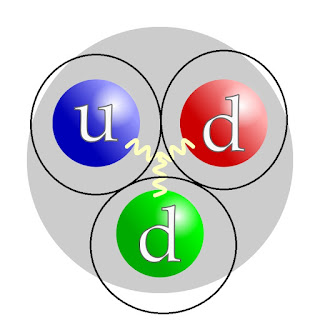
Gluons are bosons that mediate the strong nuclear interaction. This means that gluons are the glue that binds quarks into hadrons. Quarks form protons and neutrons. But those hadrons (or baryons) cannot exist without gluons. Gluons are lower-energy particles that carry energy between quarks.
Because. Gluons' energy level is lower than quarks'. That makes energy flow to gluons. That keeps quarks in protons and neutrons. When quarks spin, they form a quantum tornado around their axle. When those tornadoes from the higher-energy down quark and lower-energy up quark impact. Those impacting quantum tornadoes form the structure. That looks like a quantum-size Tesla coil. This model means that the gluon is like a photon.
The plate between quarks. That plate conducts energy.
Out from the quantum tornado that connects those quarks. Because of asymmetry. In energy between up and down quarks. The energy that comes from down quarks. Pushes that energy plate to the up quark. So. That particle that we call a gluon transports energy directly out of the structure that keeps quarks together.
This means. That the gluon itself sends wave motion. This wave motion will turn into the weak nuclear interaction. The W/Z boson interaction sends wave motion into the electron shell. The energy level outside the atom determines how fast energy travels out from atoms. If. The atom’s core takes too high an energy dose.
If. That energy dose is high enough. Strong energy flows out of atoms. It rips the atom in pieces. The reason why helium atoms are very hard to decay is simple. A high-energy photon hits one of the neutrons. The small atom can deliver that energy past the electron shell.
In large atoms. Like uranium, the atom’s core is very big. This means that the atom can store more energy than small atoms.
The interaction in the atom’s core. It sends energy impulses through the middle of the core. That can cause a situation. The distances between protons and neutrons increase. Energy flowing away from neutrons can rip a neutron into pieces. That releases free energy into the atom’s core. And that starts the fission. In fission, the energy is released from bonds between protons and neutrons. The number of bonds being cut between protons and neutrons. That determines the energy level that fission releases.
The requirement for fission is this. The atom. It cannot release free energy fast enough. Another thing that can cause atomic decay is the extremely low-energy area around the atom. That cosmic microvacuum pulls energy out of the atom so fast.
That. It rips the outermost layer of the protons and neutrons out. That cuts the bonds. That keeps protons and neutrons as the atom’s core. That releases energy that pushes energy to those electrons. Electrons emit photons that we see as a flash.
https://en.wikipedia.org/wiki/Elementary_particle
https://en.wikipedia.org/wiki/Fundamental_interaction
https://en.wikipedia.org/wiki/Gluon