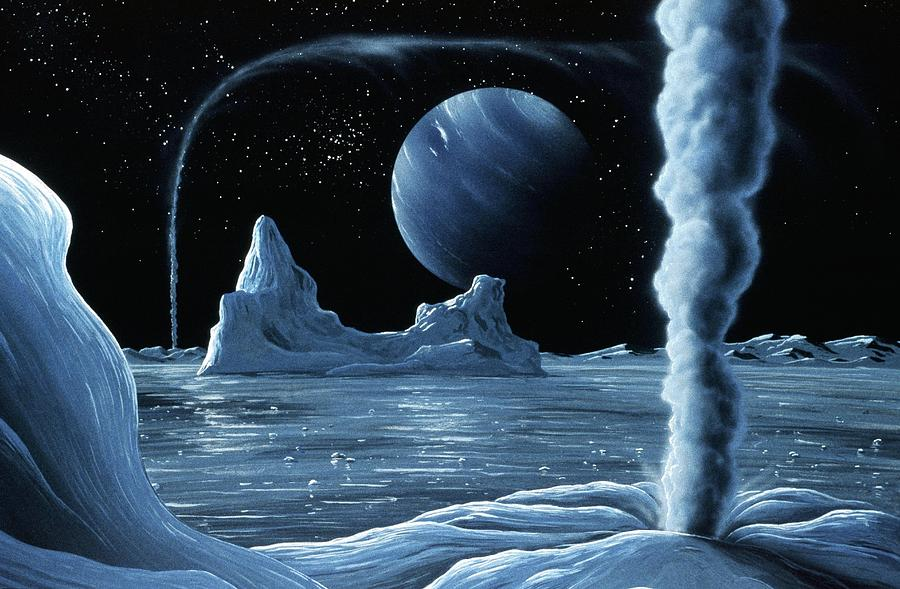
Uranus’ new moon and suspicion of Planet Y.

“James Webb has revealed Uranus’ smallest moon yet, a six-mile-wide world hidden near its inner rings. This discovery pushes the planet’s moon count to 29 and shows how Webb can uncover secrets Voyager 2 never saw. Credit: NASA, ESA, CSA, STScI, M. El Moutamid (SwRI), M. Hedman (University of Idaho)” (ScitechDaily, Uranus Has a Tiny New Moon and It’s Only Six Miles Wide)
JWST found a new moon called S/2025 U 1 near Uranus. Did the Uranus planet capture its tiny, newfound moon after the Voyager 2 flyby in 1986? The width of that moon is about 6 miles. And it is hidden in Uranus' inner rings.
Researchers noticed the new moon that orbits Uranus. That tiny moon is interesting. Because Earth-based instruments found it. That new Uranus moon is not a very big object. But it's remarkable, and the interesting thing. But I think that researchers should have found that moon before. So, could that small moon have made a transit movement to orbit the Uranus planet in the near past? That means something pulled that moon out from the Kuiper Belt.
In this hypothesis, that is the new moon for that gas giant. Something in the Kuiper Belt pushed that thing out from its trajectory. That new moon called S/2025 U 1 is the new moon for the Uranus moon family. And that tiny moon, which is only six miles wide, orbits near that planet. The Voyager spacecraft should have found that tiny moon during its flyby in 1986. So that supports the model that Uranus captured that moon after the Voyager flyby.

“A new SwRI-led JWST survey discovered S/2025 U 1 (approximate location indicated in yellow), a tiny moon orbiting Uranus between the satellites Bianca and Ophelia. If it has an albedo comparable to other nearby moons, this object is probably around six miles in diameter, by far the smallest moon in the Uranus system to date. The solid ellipses indicate rings, while the dotted lines show the orbits of many of the inner moons. Credit: Public Domain” (SwRI), M. Hedman (University of Idaho)” (ScitechDaily, Uranus Has a Tiny New Moon and It’s Only Six Miles Wide)
Forget planet X, there might be a planet Y in the Kuiper Belt.

Above: Why is there no dust on the white snow area on Pluto? That tells us that the white snow area is born recently. Or something pulls particles out from that.
Some people believe that there is a planet X, or the ninth planet, somewhere, outside Pluto’s orbit. Planet 9 is a very well-known theory. There is a suggestion that Planet 9 is about three to seven times as massive as Earth. And that orbits the sun at the edge of the solar system’s gravitational pool. There can be something smaller, an Earth-size icy world hiding in the Kuiper Belt. Or outside it. Planet Y is not such a well-known theory. Than the Planet 9.
The white area on Pluto’s surface can be a cryovolcano or a result of the recent cryovolcanism-type seismic effect. That thing can form because of the Charon-moon gravity. But there is another possibility. Something far stronger than the gravity effect can cause tidal waves that activate the cryovolcanism. The thing. What makes that white area interesting is that. There seems to be no dust in that area. That means it formed quite recently. Pluto is far lighter than Earth. And that means Charon’s tidal forces are far stronger on that dwarf planet’s surface than they would be on Earth.

"Three years after NASA's New Horizons spacecraft gave humankind our first close-up views of Pluto and its largest moon, Charon, scientists are still revealing the wonders of these incredible worlds in the outer solar system. Marking the anniversary of New Horizons' historic flight through the Pluto system on July 14, 2015, mission scientists released the highest-resolution color images of Pluto and Charon. These natural-color images result from refined calibration of data gathered by New Horizons' color Multispectral Visible Imaging Camera (MVIC). (Wikipedia, Charon)
The processing creates images that would approximate the colors that the human eye would perceive, bringing them closer to “true color” than the images released near the encounter. This image was taken on July 14, 2015, from a range of 46,091 miles (74,176 kilometers). This single color MVIC scan includes no data from other New Horizons imagers or instruments added. The striking features on Charon are clearly visible, including the reddish north-polar region known as Mordor Macula." (Wikipedia, Charon)
Pluto has five known moons, and that makes the new Uranus moon very interesting. But could those moons common gravity effect be strong enough? To hover those particles out from Pluto's surface? Charon itself is grey, and it can be covered by cosmic dust. But was that moon once in the middle of the cosmic dust flow? And why do those particles not reach Pluto?
The problem is: why is there no visible cryovolcanism or cyoseismic effect in the images? Which New Horizons tool during its flyby? If that cryovolcanic effect happened only once. That would cause interesting thoughts.
Researchers are finding tips that the large, maybe, Earth-mass planet can hide in the Kuiper Belt. That planet can be more interesting than Planet 9. Planet Y can give some answers to the Early solar system formation. But researchers need more evidence. To confirm the existence of this icy Earth. Maybe the Vera Rubin Observatory can give an answer for that question. The researchers can use the accumulation of the dust and gas around hiding objects that could hide at the edge of the solar system.
The problem is that those objects are very cold. And if they used their internal thermal source, those big planets can turn invisible to the IR sensors. But their gravitational effect can disturb their moons. Big and heavy objects capture smaller objects around them. And maybe the tidal forces can form the cyovolcanism in those small objects. The Kuiper Belt is a very stable environment. If there are big planets, their trajectories can be so far away from the Sun and other planets that they can escape from our solar system.
https://dailygalaxy.com/2025/08/planet-y-haunting-space-beyond-neptune/
https://www.earth.com/news/planet-y-signs-of-a-world-hiding-in-our-solar-system/
https://www.newscientist.com/article/2493480-there-might-be-a-planet-y-hiding-in-the-outer-solar-system/
https://scitechdaily.com/uranus-has-a-tiny-new-moon-and-its-only-six-miles-wide/
https://en.wikipedia.org/wiki/Charon_(moon)
https://en.wikipedia.org/wiki/Planets_beyond_Neptune
https://en.wikipedia.org/wiki/Pluto