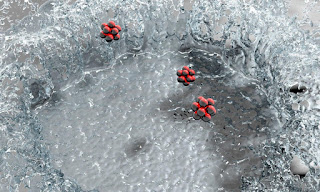
The half-moon-looking robots can cut molecules into pieces. Those molecular-size robots can hang from the surface tension of water and other liquids. Then the swinging motion of those robots would make them useful to use as the cutters that cut the molecules in pieces.
When the nanomachine swirls. The form of it would make it possible. That the other side of the machine will go through the surface. The requirement for cutting molecules by nanomachine is it will go through the molecule. Or there is some enzyme the cuts the targeted molecule. In the cases that we want to clean water by using nanomachines, they should build a large number.
If a single nanomachine cannot make that thing. There is the possibility to put molecule sticks between two nanomachines. The swirling nanomachine can cut the molecules. Those are on the surface of the liquid. There is the possibility to make small scissors by using similar structures.
In those scissors, the other side would be this type of nanomachine. And the other side would be stable. That thing is useful for moving other molecules. But if there is a molecule that will hover extremely close to the surface of water that makes this kind of nanomachine is useful to cut the oil molecules. And if those small scissors can react to things like electricity. They can use to fix single cells.
The snowflakes as the form of nanomachines
The form of nanomachine is important. If we want to make nanomachines that are moving on the layer we can make the star or snowflake-looking molecule there are opposite polar ions or rather saying ions and anions at the end of corners. Those nanomachines can move on the layer. When the electric polarity of the layer will change. That thing will push anion upward and ion downward. This effect will make those nanomachines roll on the layer. If the nanomachines can operate at a temperature that is below zero degrees celsius. Snowflakes can use as nanomachines. But if the operating temperature of the machines is higher.
The DNA can use control the growth of those crystals. That means that the form of those snowflakes can store in the DNA. And that thing automatizes the production of those systems.
This system requires some other material. And that star-looking nanomachine can be made by using carbon chains. If we want to clean large water areas by using this type of nanotechnology. We can pull a magnetic layer below the surface and those nanomachines can cut the molecules on the surface.
Some nanomachines are like coil springs. The simplest model of the coil springs molecule that can move is the long molecule. There are ionic materials on both sides.
Another material is an anion. And another is an ion. When the polarity of the layer changes it pulls the nanomachine up. There could be a laser or some kind of (electro)magnetic ray that can turn the nanomachine around while it jumps. And then it should drop to the layer opposite way.
Cutting molecules by using those tools is an impressive thing. But if we want to be accurate there is needed some other structures. The running nanomachines can connect with those swirling nanomachines. In that case when the layer where nanomachine stands are going farther. The internal electromagnetic interaction of the nanomachine pulls the molecule shorter.
Normally the same effect is made by adjusting the electricity on the layer. The researchers can make running nanomachines by connecting ions with coil spring-looking structures. When the polarity of electricity changes that will kick those ions up.
The ions in that structure have different polarities. They are ion and anion. In that case when the other ion jumps up. The other will go down. That thing makes those robots run on the layer. That kind of robot can cut long molecules like DNA. Or some carbon chains. And they are useful tools for many purposes.