Showing posts with label splitting photons. Show all posts

Tuesday, August 19, 2025

Researchers split a photon into two pieces.

Researchers split a photon into two pieces. 


"By splitting a single photon, scientists confirmed that angular momentum is always conserved — a billion-to-one experiment that reinforces the foundations of quantum physics. Credit: SciTechDaily.com" (ScitechDaily, Scientists Just Split a Single Photon. Here’s What They Found)

The image above introduces a situation. The wave movement impacts a photon. That thing makes the photon oscillate and send a wave movement. That thing can also split a photon into two pieces. When a photon travels in a quantum network. Transporting information. The system must store information about that photon. 

And after that, the system must also download information from that photon. The very thin wave bites could act like the needle of the gramophone. The system scans the depth of the waves that are on the photon’s surface. The quantum system stores information in those waves. And the number of waves determines how many states the qubit can have. Another determinant is the depth of those waves. 

Researchers at the University of Tampere split a photon into two photons. That thing proved that even photons follow one of the basic rules in physics: the conservation of angular momentum. So, if the system can make photons act like a gyroscope. And keep those photons in the same position, which makes a new advance in photonics and quantum computing. A series of superpositioned and entangled photons can transport information in nanotube-based systems. 


"Schematic of a single photon with zero angular momentum (green) splitting into two photons (red) with either zero or opposite angular momenta (sketched through the spatially varying color), which adds up to zero confirming the fundamental angular momentum conservation law. Credit: Robert Fickler / Tampere University"(ScitechDaily, Scientists Just Split a Single Photon. Here’s What They Found)


Splitting a photon into two photons by aiming a laser beam, or a wave movement through it. It is one of the things that can make quantum networks closer to reality. In a quantum network, information is stored in particles, like photons.  In a quantum network, particles travel and transport information. In a regular network, wave movement acts as an information transporter. 

The problem with the quantum network is this. Those particles that travel in that network. Should not touch anything unexpected. Any field or unexpected error in the quantum network causes a situation. There is information that particle transport can be damaged. The problem with error detection is this. The system cannot detect errors that happen in some quantum line. 

The answer for error detection is to send information using two separate lines. If those lines create identical solutions, the answer is ” probably closer, right than wrong”. In reasonable circuits. The system makes all calculations backward. And if the answer is the original values, the system gives the right answer. But if the system transports information into two lines, it must split that thing into two routes. 

In a quantum network. That requires that the system must create two identical information packs. So, the ability to split photons can be a tool for quantum routers. But the system can use this technology in quantum computers. Splitting photons and putting them into superposition and quantum entanglement is one thing that can make the quantum chips closer to everyday reality. The information that photon also follows the principle of angular momentum is the thing. That can be important for quantum technology. If the system knows when photons “fall” in quantum entanglement, that can improve the quantum system's effectiveness. 


https://scitechdaily.com/scientists-just-split-a-single-photon-heres-what-they-found/


https://en.wikipedia.org/wiki/Angular_momentum

Monday, December 20, 2021

Beyond the standard model and curving spacetime

 Beyond the standard model and curving spacetime 


Image 1:


The splitting photon along with the Muon G-2 anomaly caused a situation. Re-estimation of the entire standard model of particle physics is needed. The question is that what if the photon is not an elementary particle? The photon or every other elementary particle can be superpositioned. But they cannot split in two. What if the photon is some kind of meson? And that thing causes another thought. What if there are some other particles like quarks that involve other particles. 

The thing is that we should look for the particles that are connecting the photons. Like gluons are connecting quarks. So is the particle that makes photon stay in one piece some very small and very energetic particle that looks like gluon. The splitting photons are giving a tip that the Majorana-particle exists. 


But could that mysterious "Majorana Particle" or "Majorana fermion" actually be a hadronic boson? Could it be possible that some Fermions are bosons? 


And could that "Majorana Boson" be the graviton. Graviton is the hypothetical transportation particle that transports gravitation. So if the graviton is the thing that keeps the photon together. It should be a very small, and at the same time high energetic particle. 

The thing that photons are splitting means they cannot be elementary particles. The elementary particles are not splitting. The term elementary particle means that there are no other particles in it. But if even a photon is not an elementary particle. That means that there might be some other particles that are just believed to be elementary particles. But they involve something smaller particles. 

So could there be other yet unknown particles inside quarks and even gluons? Or is it possible that we don't know any real elementary particles? There is predicted an exotic six-quark particle by using supercomputers. But is it possible that there are super protons or super neutrons where are seven or more quarks? But are there sub-structures also in the quarks? understanding the interactions of particles and gravitation are required for making TOE(Theory of Everything). 


Image 2: 


x-x-x-x-x--x-x-x-x-x-x-x-x-x-x-x-x-x-x-x-x-x-x-x-x-x-x-x-x-x-x-x-x-x-x-x-x-x-x-x-x-x-


Is gravitation some kind of superposition?


The main question about gravitation is could the graviton exist? And the second thing is is it pulling or pushing force? And one of the questions is: could the gravitation be some kind of superposition effect. The idea is that the hypothetical gravitons are forming the strings between each other. And those strings are pulling or pushing the gravitons to each other. That graviton-connected string starts travel from the higher energetic object to the lower energetic object. 

Then those strings which are are wave-movement or energy start to pull those gravitons together. So the gravitation would be the wave movement that travels from the higher energetic area to the lower energetic area. Like all other forms of energy. The question is: does the gravitation travel the opposite way against the flow of those hypothetical gravitational strings. 

x-x-x-x-x--x-x-x-x-x-x-x-x-x-x-x-x-x-x-x-x-x-x-x-x-x-x-x-x-x-x-x-x-x-x-x-x-x-x-x-x-x-


Image 3: 


Curvature of spacetime


Measurements of the curving spacetime are the thing that is used to confirm Einstein's Theory of General Relativity. There have not been found errors. And that is the evidence of the extraordinary well-documented theory. The Theory of Special Relativity is the thing that can use in a straight universe. But the Theory of General Relativity is suitable for curving spacetime. 

When we are thinking about the curvature of spacetime in the 3D environment we must realize the thing that the curving spacetime is curving all around the object. So the rubber levels and iron balls are not helping us in modeling that phenomenon. 

When we are thinking that curving space around the massive object has the ball form. We should think that space is getting shorter in that area. The thing is that modeling the curvature in a 3D environment is very difficult. So when the object is curving spacetime we should think that there is a ball-looking pit in the spacetime. So the curvature of spacetime around the 3D object is more like a tunnel than the pit.

The Brane theory is one of the things that can model the curving spacetime in a 3D environment. The branes or layers are surrounding the gravitational center at a 360 degrees angle. And those layers are also surrounding the central object of gravitation from all directions. That theory is created for modeling the gravitation effect. But the problem is that researchers can just model the gravitational interaction between one layer and the gravitational center. 

The problem is that there might be one common gravitational center in the area. But there are also sub-centers. As an example, Sagittarius A is the gravitational center of the Milky Way but the local gravitational center in our solar system is the Sun. And if we increase accuracy the Earth is the gravitational center for the moon etc. 

The problem is that the gravitational center is not only a black hole or some other most massive object in the area. Every single object is turning gravitational center if we are using high-enough resolution. If we are using high enough accuracy.

Even a single electron is turning to a gravitational center if the zoom is high enough. And the gravitation is interaction. That means there is no straight universe at all. If we use high-enough resolution. And at that point, I must say that every gravitational center is acting the same way. But the pit that the gravitation is making is always depending on how powerful gravitation is. The black holes are extreme objects, but also other objects are curving spacetime. 


The gravitational interaction curves spacetime also around other objects than just the gravitational center. 


Above is the image of the curvature spacetime. There are three objects the Sun, the moon, and Earth. The gravitation of the Sun pulls Earth to the Sun. But the centripetal force keeps it at the trajectory. And then the moon is also pushing energy to the Earth. 

When the moon is orbiting the Earth. The direction of its gravitation effect changes. When the Moon is at the side of the Sun it pulls Earth stronger than when it's at another side. Also, the side-movement is chancing the energy transportation. 

And then that thing is pumping energy to the Earth. But the thing that makes energy transportation and modeling difficult is that gravitation and energy transportation is interaction. This means that energy travels also from Earth to the Moon. 

Also, things like gravitational waves are the thing that transmits energy. Maybe gravitational waves have no big effect in large systems. But they can affect microgravitational systems. And if the gravitational waves affect billions of years. They might cause some even large-scale effects.


Sources:


https://muon-g-2.fnal.gov/


https://www.newscientist.com/article/2301876-photons-could-be-split-in-two-to-create-a-weird-new-form-of-light/


https://phys.org/news/2021-12-exotic-six-quark-particle-supercomputers.html


https://scitechdaily.com/split-photons-new-research-predicts-the-existence-of-a-previously-unimaginable-particle/


https://www.techexplorist.com/new-groundbreaking-technique-reveals-new-details-long-theorized-fifth-force-nature/41165/


https://en.wikipedia.org/wiki/Boson


https://en.wikipedia.org/wiki/Brane


https://en.wikipedia.org/wiki/Curved_space


https://en.wikipedia.org/wiki/General_relativity


https://en.wikipedia.org/wiki/Graviton


https://en.wikipedia.org/wiki/Majorana_fermion


https://en.wikipedia.org/wiki/Neutrino


https://en.wikipedia.org/wiki/Sagittarius_A*


https://en.wikipedia.org/wiki/Spacetime


https://en.wikipedia.org/wiki/Special_relativity


https://en.wikipedia.org/wiki/Standard_Model


https://en.wikipedia.org/wiki/Subatomic_particle


https://www.zmescience.com/science/physicists-claim-that-a-photon-can-be-split-into-halves/


Image 1: https://en.wikipedia.org/wiki/Spacetime


Image 2: https://en.wikipedia.org/wiki/Standard_Model


Image 3: https://forum.babylonjs.com/t/general-relativity-simulation-of-spacetime-curvature-due-to-mass/10731


Tuesday, December 14, 2021

Split photons predicted the new unimaginable particle's existence.


 Split photons predicted the new unimaginable particle's existence. 


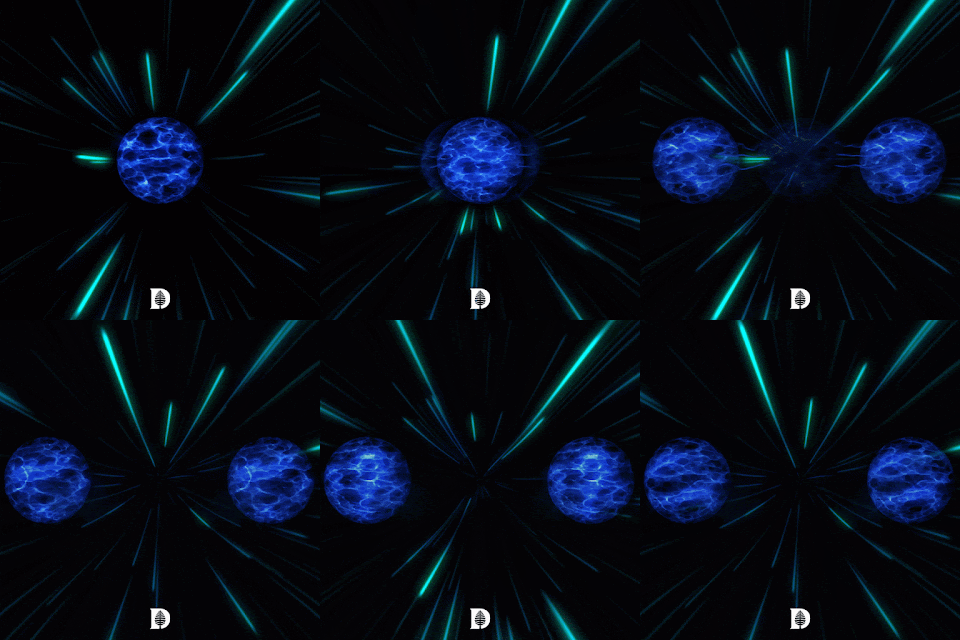
"The finding of the Majorana boson demonstrates that photons can be “split” into halves. Credit: Animation by LaDarius Dennison" (ScitechDaily/“Split” Photons – New Research Predicts the Existence of a Previously-Unimaginable Particle)

The split photon called "Majorana bosons" is the thing that gives an idea that maybe there are particles in the photons. If the photon is not an elementary particle in the group of bosons. That means we are facing a new type of physics. So we must rethink the standard model. If the photon is not a boson or even an elementary particle it should be like some hadron. Or rather say pion or kaon. 

So is photon some kind of meson? The future will show that thing. But the idea that there is some kind of particles inside the photon is interesting. There is of course possible that the "Majorana-fermion" could exist in the photons. But there is possible that the "Majorana-fermions" can also involve some other particles. The best candidate for Majorana-particle is the neutrino. And it's also possible that there is also Majorana boson. That means that maybe Majorana missed something and the Majorana-particle is a boson. 


Majorana fermions are enigmatic particles that act as their antiparticle themselves. And Majorana fermions were first hypothesized to exist in 1937. They are of immense interest to physicists. Their unique properties could allow researchers to use those particles. For the construction of a topological quantum computer. 

https://www.sciencedaily.com/releases/2020/01/200103141035.htm


Image 2.


The existence of the Majorana fermions predicted Italian physicist Ettore Majorana in 1937.  "In supersymmetry models, neutralinos—superpartners of gauge bosons and Higgs bosons—are Majorana". (Wikipedia, Majorana fermions) 

But the question is. Could there in the "Majorana-particle" some even smaller particles? 


If Majorana-particle is in photon, that we have thought being elementary particle in the group of bosons. Why that "Majorana-particle", cannot be some kind of meson? Or a member of another hadron group? Maybe those Majorana particles are members of not yet group of hadrons. 

Or are there missing particles inside pions or kaons? When we are thinking that as an example pion is forming of the quark and antiquark pair, what is the thing that denies the annihilation of that particle pair? Is there some small particle between them? 

When our knowledge of the matter and fundamental states of the time, space, energy, and particles and their interaction. We are facing one of the most fascinating things in the universe. What is the thing that limits the speed of light? 

The idea that photons split in two seems insane. But the researchers are founded cases, where photon splits. And that thing gives a tip. That maybe there is some yet unknown particle inside photons. Maybe that unimaginable particle can answer the question of why nothing can travel faster than the speed of light. There is the possibility that this particle that we might call a "sub photonic particle" is the graviton. Graviton is a hypothetical transportation particle of gravitation. But those things are only hypotheses. 


https://www.sciencedaily.com/releases/2020/01/200103141035.htm


https://en.wikipedia.org/wiki/Fermion


https://en.wikipedia.org/wiki/Graviton


https://en.wikipedia.org/wiki/Kaon


https://en.wikipedia.org/wiki/Majorana_fermion


https://en.wikipedia.org/wiki/Pion


https://en.wikipedia.org/wiki/Standard_Model


Image 1:https://scitechdaily.com/split-photons-new-research-predicts-the-existence-of-a-previously-unimaginable-particle/


Image 2: https://en.wikipedia.org/wiki/Standard_Model


https://thoughtandmachines.blogspot.com/


Could a graviton be a low-energy photon?

Image of a photon. We can think of gravity as forming when particles or objects spin. That spin binds energy from around it. That spin turns...