Showing posts with label black holes. Show all posts

Wednesday, April 15, 2026

What if dark matter has more than one form?


"In the constellation Ursa Major, the Pinwheel Galaxy (Messier 101) is surrounded by smaller companions, including the irregular dwarf galaxy NGC 5477. Hubble observations reveal regions of active star formation within NGC 5477, while also capturing distant galaxies shining through it, highlighting the vast emptiness within galactic structures. Credit: ESA/Hubble & NASA" (ScitechDaily, What if Dark Matter Has Two Forms? Bold New Hypothesis Could Explain a Cosmic Mystery)

This means that dark matter could be more than one or two things. This means that dark matter can be some kind of particle. Or it could be the whirl in gravitational fields. In the last cases, the quantum fields that interact with each other can form vortices in each other. The effect could be similar. As in the cases where two rivers connect to each other. When water from a tributary impacts the main river, a whirl forms. And. In the same way, when a quantum field. Impact at a certain angle. There should form similar whirls, and maybe those whirls explain some part of dark matter. 

Also. The fast-spinning particles that form the quantum tornado can form an effect that we see as dark matter. Dark matter. It is a mysterious gravitational effect. And one thing. That. We might think that whirls in the impacting gravitational waves can also explain that mysterious gravitational effect. 

But then. There are theories that quantum-sized black holes can form dark matter. The black hole is more than just the event horizon and material disk. The black hole forms a giant whirl at its spinning axle. Those whirls can put quantum fields into motion. 


"New research suggests that in reduced dimensions, particles can defy the usual boson–fermion divide by exhibiting tunable, intermediate quantum properties. These findings hint at previously unexplored forms of matter and set the stage for experiments probing the deeper structure of the quantum world. Credit: Shutterstock" (ScitechDaily, Physicists Discover a Strange New Kind of One-Dimensional Particle)


There is a possibility that extremely fast-spinning 2D particles can also be behind dark matter. In that case, the edge of the saucer-shaped, fast-spinning particles drives energy out from the particle. That causes a similar effect. A fast-spinning plate causes water. That forms a whirl that can pull things inside it. And a fast-spinning particle can form a similar whirl in the quantum fields. 

Also. Things like gamma-rays. That travel through particles and atoms can raise their mass. Things like cosmic voids can also form an effect. That seems like gravity. The differences in the strengths of quantum fields can also put energy into motion. This means that some parts of the dark matter can be virtual. The effect. That form. When those quantum fields have differences in their strength. 


https://scitechdaily.com/physicists-discover-a-strange-new-kind-of-one-dimensional-particle/


https://scitechdaily.com/what-if-dark-matter-has-two-forms-bold-new-hypothesis-could-explain-a-cosmic-mystery/


Thursday, November 13, 2025

The existence of tachyons explains the nature of gravity.


Can tachyon be the same as graviton? Tachyon is a hypothetical faster-than-light particle.  That particle cannot exist in the 3rd dimension because nothing can travel faster than light. The graviton is a hypothetical. Transporter boson of gravity. If we think of a possibility. That we could find tachyon in our universe. That point is near black holes. There are models that we cannot observe tachyons. Because. When they interact with 3D particles or space and time. Tachyons release their energy immediately. That means a photon can form when a tachyon releases its kinetic energy. And the ring shape of the photon supports that model. 

The idea is this. When a black hole binds energy, or quantum fields from around it. And turns those fields into kinetic energy. That energy turns some particles into tachyons. If tachyon exists. It can escape from a black hole. So, that means tachyons can be a source of so-called Hawking radiation. If a tachyon travels in the universe, it can leave a similar energy cone behind it. 

As an aircraft leaves. When it travels faster than sound. If a tachyon can form a quantum version of a sonic boom, that means the quantum low pressure follows that hypothetical particle. That thing makes. Quantum fields fall into those cones. And that explains why gravity can only pull things. The tachyon can also make the Hawking radiation possible. 

"A tachyon or tachyonic particle is a hypothetical particle that always travels faster than light. Physicists posit that faster-than-light particles cannot exist because they are inconsistent with the known laws of physics. If such particles did exist they perhaps could be used to send signals faster than light and into the past. "(Wikipedia, Tachyon)

"According to the theory of relativity this would violate causality, leading to logical paradoxes such as the grandfather paradox. Tachyons would exhibit the unusual property of increasing in speed as their energy decreases, and would require infinite energy to slow to the speed of light. No verifiable experimental evidence for the existence of such particles has been found." (Wikipedia, Tachyon)

"The term "tachyon" derives from a 1967 paper by Gerald Feinberg about excitations of a quantum field with imaginary mass. Subsequent work has shown the excitations are not faster than light particles but particle physicists still discuss "tachyons", e.g. in tachyon condensation, when they are referring to tachyonic fields." (Wikipedia, Tachyon)


"A new theory, that explains how light and matter interact at the quantum level has enabled researchers to define for the first time the precise shape of a single photon. Credit: Dr. Benjamin Yuen" (ScitechDaily, Quantum Leap: Scientists Reveal the Shape of a Single Photon for the First Time)

When tachyon arrives. Into the 3rd dimension, it would release its extra energy as a ring-shaped energy wave. So the photon, or at least some of the photons, are the remnants of the tachyons that slow their speed immediately when they arrive in the 3rd dimension. Here, they slow their speed and leave the sockwave behind them. That means a photon could be a similar shockwave to what an aircraft causes. When it crosses the speed of sound. And maybe those shockwaves are photons. 

But near black holes, the massive gravity pulls quantum fields into the black hole. There, the hypothetical tachyon can travel against the quantum fields. That travels into the black hole, the tachyon that can escape from the black hole can exist because the quantum field that travels against the tachyon allows it to cross the speed of light virtually. When a quantum field travels to a particle. And impacts it, the impact speed can be faster than the speed of light. If a particle travels 60% of the speed of light, and a quantum field travels against it with 70 % of the speed of light. 

The impact speed is 130% of the speed of light. That thing is called border crossing. The neutrino telescope benefits from a similar effect. When a neutrino travels into Earth's atmosphere and water, it travels faster than the speed of light in a medium. The neutrino must slow its speed, and during that process, it sends a blue light shockwave. That shockwave is like a quantum version of a sonic boom. 

When we think of a possibility. That a hypothetical graviton is the same thing as a tachyon. When a hypothetical tachyon travels out from the black hole. It can leave a similar cone behind it. As an aircraft leaves. When it travels faster than sound. That cone is called a sonic boom. If a tachyon leaves that kind of cone after it. If there is. Some kind of lower energy area. Energy around it starts to fill that area immediately. If a black hole sends those hypothetical tachyons, they could form the lower-energy area around it. If those hypothetical tachyons. Come out of a black hole. As pulses. That explains black hole quakes. And that explains why gravity has only one way effect. The cone that tachyon forms after it pulls particles into it. 


https://scitechdaily.com/quantum-leap-scientists-reveal-the-shape-of-a-single-photon-for-the-first-time/


https://en.wikipedia.org/wiki/Fundamental_interaction


https://en.wikipedia.org/wiki/Graviton


https://en.wikipedia.org/wiki/Hawking_radiation


https://en.wikipedia.org/wiki/Tachyon

Friday, September 26, 2025

It’s possible that a wormhole opened in the universe for ten milliseconds.


"The most massive binary black hole merger. This graphic shows a still from a numerical relativity simulation consistent with GW190521. The ripples illustrate the spacetime curvature and gravitational waves produced by the pair of merging black holes. The bottom shows the gravitational wave signal as a function of time. The left shows representations of the black hole event horizons for GW190521 and other massive black hole binaries detected by LIGO/Virgo. (Credit: D. Ferguson, K. Jani, D. Shoemaker, P. Laguna, Georgia Tech, MAYA Collaboration). (Phys.org, Study shows that the GW190521 event could be explained by primordial black holes)

Do you know what gravitational wave  GW190521 is? Researchers think. This gravitational wave formed. In a primordial black hole merger. That means those primordial black holes can bring information from the time before the universe existed or formed. Maybe it’s evidence of the wormholes, energy bridges across the universe. In models, the wormhole. The Einstein-Rosen bridge forms between two black holes that oscillate at the same frequency. That means the wormhole is the superposition and entangled black holes, or the superposition’s “Einstein’s spooky action at a distance” between black holes. And that means the wormhole is the black hole. Or the extreme version of quantum entanglement. 

If the gravitational wave GW190521 was formed when a wormhole opened in the universe, the gravitational wave GW190521 uncovers the most interesting phenomena in the universe. That thing proves that Einstein was right, and the Einstein-Rosen bridge is true. 

There is also other, so-called non-straight evidence of the wormhole. When black holes merge, they produce a larger event horizon than both of them had. There is a possibility that when black holes collide, they pull the wormhole open. And that wormhole, if it exists, pushes energy into black holes. In that model, all black holes are connected to the wormhole. When black holes merge, those wormholes are separated from the singularity and bring more energy into the event horizon. That bulges like a balloon. In some models, the singularity is actually like a ring. When black holes spin, the extremely strong force pulls the hole into that extremely dense structure. 


“The cosmic web is part of the universe's large-scale structure. It is composed of dark matter, gas, and galaxies. A frame from the Illustris Simulation shows a massive galaxy cluster at the center. Red, orange, and white colors show hot gas, while the blue and purple filaments depict a cosmic framework of dark matter. Credit: Illustris Collaboration” (Astronomy, What is the cosmic web made of?)


"A wormhole visualized as a two-dimensional surface. Route (a) is the shortest path through normal space between points 1 and 2; route (b) is a shorter path through a wormhole." (Wikipedia, Wormhole)


The wormhole also explains dark energy. When a particle travels in the wormhole, it cannot turn older. Otherwise, we can say that the particle cannot release its energy. When a particle comes out of the wormhole, it suddenly releases the energy that is stored in it. Because the future is lower energy than the past, the particle is at a higher energy level than it should be. In the same way, the radiation that travels in the wormhole has a higher energy than the radiation outside the wormhole. 

There is a possibility that  ion whirls can form a wormhole if the speed of that whirl is high enough. In that case, the ion whirl pumps energy to the object inside it. The idea is transformed from the Tipler Cylinder. There, the fast-spinning cylinder stops or dilates time inside it. The idea is that the wormhole locks energy in the object, and that stops time inside it. 

There is also evidence that not all black holes are spinning. The thing is that the black hole's spin is relative to other black holes. And if two black holes spin with the same speed, and they are just in line, they might look frozen. Or their spin is impossible to see if we observe that black hole pair. So if black holes are in a chain and all of them spin in the same direction with the same speed, those black holes look static if we compare them with other black holes in the chain. 

The thing. That supports the wormholes. Or their existence, at least in some form, is the intergalactic material flows. In those cases, in those extremely large megastructures, there must be some kind of channel or structure that pulls material around them. The structure is a combination of dark matter, galaxies, and ions, but the main question is what pulls these structures together. Into the form. That looks like a slime mold. There is something that pulls dark- and visible matter into the network-shaped structure. 

This means that the so-called cosmic web can be the wormhole network. This is one way. To see things. We are made of acoustic and electromagnetic wormholes. But. Confirming the gravitational wormholes would be the most fundamental event in physics. This thing can also bring evidence of the multiverse. 


https://www.astronomy.com/science/what-is-the-cosmic-web-made-of/


https://phys.org/news/2021-03-gw190521-event-primordial-black-holes.html


https://www.rudebaguette.com/en/2025/09/scientists-detected-a-signal-from-another-universe-wormhole-opened-for-10-milliseconds-while-physics-community-panics-about-parallel-worlds/


https://www.sciencealert.com/unusual-gravitational-wave-may-be-sign-of-wormhole-linking-universes


https://scitechdaily.com/astronomers-discover-colossal-cosmic-bridge-linking-galaxies-across-space/


https://scitechdaily.com/einstein-was-right-again-ripples-in-space-time-confirm-century-old-theory/


https://en.wikipedia.org/wiki/GW190521


https://en.wikipedia.org/wiki/Observable_universe


https://en.wikipedia.org/wiki/Quantum_entanglement


https://en.wikipedia.org/wiki/Tipler_cylinder


https://en.wikipedia.org/wiki/Wormhole


Saturday, September 20, 2025

Hawking was right. Black holes’ event horizons cannot withdraw.

Hawking was right. Black holes’ event horizons cannot withdraw.


“Computer simulation of the black hole binary system GW150914 prior to merging. Credit: SXS” (Universe Today)


It’s possible that all black holes spin. 


Hawking was right about black holes. Their event horizon cannot withdraw.  When two black holes collide, their event horizons’ size is as big as both of those black holes before they collide. When black holes collide, they send a gravitational wave. And that wave is an energy impulse that forms when those black holes collide, meaning a small portion of their mass is converted into energy that is released as gravitational waves. But why does the size of those black holes' event horizon not decrease? 

The reason for that is in the nature of the spacetime and the universe. The thing that keeps a black hole in its form is the material and energy that forms a whirl around it. As the universe expands, the quantum fields and material pressure against the black hole weaken. That means that. The energy that keeps the black hole in its form turns weaker. When a black hole sends gravitational waves, it sends its event horizon’s “shell” away from it. The idea is that decreasing the energy level of the whirl around the black hole sucks energy out from the event horizon. 

In that model, the gravitational wave forms. When the whirl around the black hole jumps out of it. When the energy level in the whirl around the black hole decreases, that whirl jumps out from the black hole. The Schwarzschild radius is the singularity’s distance to the point at which the escaping velocity reaches the speed of light. That distance depends on the mass of the singularity. The Schwarzschild radius doesn’t depend on the whirl that surrounds the black hole. Actually, the Schwarzschild radius depends on the black hole’s mass and energy relation with its environment. 

The idea is that when we are in the middle of the quantum system. And we face a global change. That affects all particles. When a black hole loses its mass, the universe or space around it loses its energy in the same relation. That means the relation with the black hole and its environment is the same. We cannot see global changes in the system if we are in it. 

All mass in a black hole is in the structure called a singularity, where material, energy, and time are connected together. In this model, gravity waves form in the black hole’s gravity field. In that process, the black hole loses a photon. 

The interaction between the black hole and its environment is complicated. Materia is one energy form. It’s like a pack of energy. You can imagine what energy level is stored in a singularity, where an entire star, whose mass is many suns, is pressed into a size that is smaller than an atom. That is a lot of energy packed in a very compact space. Otcoming energy keeps that structure in its form. And without that energy that comes from outside, the energy  stored in that structure is released. So, the mass is relative to its environment. When a black hole binds energy from its environment, its own energy level rises. That process happens because a black hole spins. Without that spin, the black hole, or its singularity, cannot bind energy that travels against it. 


Above: A Spiral galaxy is a whirl around a supermassive black hole.(Wikipedia)


The singularity must bind more energy than travels into it because its energy level must turn lower than the energy that comes from the environment. The sigularity stores energy. If the energy level that the singularity can release turns higher. Than its environment. That thing starts to evaporate. So the question is not about how much energy is stored in the singularity. The question is about. How much energy can it release? When singularity releases its energy, it must have a higher energy level than the whirl it brings into it. Energy and material continue their spiral-shaped trajectory behind the event horizon. So the whirl around the event horizon continues behind the event horizon, and that spiral structure turns tighter and tighter. Without that whirl, the black hole will detonate. 

That spinning movement forms the whirl around it. And we see those whirls. Around supermassive black holes. As a spiral galaxy. This means that it's possible that the only existing black holes are spinning black holes. This spinning movement forms an energy transition in the singularity. Without that spin, the black hole would release energy. And that causes detonation. This means gravity forms when spinning particles bind energy, or quantum fields into them. That energy transports particles to those gravity centers. 

The mass is also relative to its environment and the gravitational field. Energy levels in energy fields are relative. To other energy fields, energy levels. Even if a black hole loses its mass, its environment loses its energy. And that means the black hole’s mass compared to its environment is stable. 

When we say that black holes oscillate, we mean that black hole sends gravitational waves. That doesn’t mean that the event horizon moves backward. The interaction means that the environment sucks those waves away from the event horizon. That means the point where the event horizon was before the gravity waves stays stable. 

The event horizon is the locked energy that surrounds. Something inside that structure. The distance of the event horizon from the core of the black hole is the Schwarzschild radius. Black holes spin, and that spin binds energy from around that thing. A black hole binds energy from its environment. And transforms it into kinetic energy. This process is one of the forms of gravity. The whirl, or the transition disk around the black hole, keeps that structure in its form. The whirl pushes energy to the black hole. Without that, the black hole detonates. When the universe expands, energy in that whirl turns lower. And that allows the black hole to send a gravitational wave. 

And then another layer in the event horizon takes the place of the shell that was left out of the event horizon. The idea in that model is that. The structure in the event horizon forms layers, which means the gravitational structure in the event horizon. Looks like an onion. The Schwarzschild radius is the distance to the point where the escape velocity reaches the speed of light from the singularity that exists in the center of the event horizon. Because the Schwarzschild radius is static until the singularity starts to lose its mass, the gravitational wave doesn’t decrease the black hole’s mass. The time that the whirl is separated from the event horizon is so short that this interaction has no time to reach the black hole’s core. But if that whirl is gone and the black hole cannot get energy. This causes the black hole to evaporate. And if a black hole is in a cosmic void, we would see that event as a detonation. 


https://www.britannica.com/topic/event-horizon-black-hole


https://as.cornell.edu/news/hawkings-black-hole-theorem-observationally-confirmed


https://www.livescience.com/physics-mathematics/quantum-physics/stephen-hawking-s-black-hole-radiation-paradox-could-finally-be-solved-if-black-holes-aren-t-what-they-seem


https://news.mit.edu/2021/hawkings-black-hole-theorem-confirm-0701


https://www.spacedaily.com/reports/Black_hole_merger_provides_strongest_evidence_yet_for_Hawking_area_law_999.html


https://www.universetoday.com/articles/black-hole-merger-provides-clearest-evidence-yet-that-einstein-hawking-and-kerr-were-right


https://en.wikipedia.org/wiki/Hawking_radiation


https://en.wikipedia.org/wiki/Schwarzschild_radius


Monday, August 25, 2025

Can dark matter transform planets or red dwarfs into a black hole?

     Can dark matter transform planets or red dwarfs into a black hole? 


"Black hole inside? Exoplanet observations could provide a new way to search for superheavy dark matter. (Courtesy: NASA/JPL-Caltech)" (Physics world, Exoplanets suffering from a plague of dark matter could turn into black holes)

Theoretically, any object in the universe can transform into a black hole. That means dark matter can form a black hole like visible matter. Dark matter can also play a role in cases where small red dwarfs or planets turn into black holes. There are no observations about those planetary-sized black holes. But they can exist. 

Theoretically, black holes' relativistic jets. Or supernova explosions can turn a planet’s atmosphere into super-high temperatures. And this can cause energy to flow into the planet’s or a small star’s core. And if the gravity field travels to the front of the shockwave, that can cause a situation where the object just vanishes. 

Dark matter that travels into the small object’s core can pull that core into form. There, the self-sustaining nuclear fusion can begin. The mass of the star should be high enough that the whirls and entropy cannot break the fusion core. If the star is too light and fusion starts, it blows the star’s shell out. And that pulls the fusion core larger, causing energy loss. 

If a star is too heavy, the fusion that starts in the middle of it can be too strong. And that blows the star’s shell outside. The loss of energy causes a different situation. Gravity pulls the shell back into its form. And then the star turns into a black hole, immediately when its fusion begins. In the cases of the heaviest nebulae, the nebula can fall straight into the black hole. 


When we think about the possibility that dark matter can transform a planet into a black hole, that can happen in two ways.

1) The dark matter can move into the planet’s core and pull it into a black hole. 

2) Dark matter can form a plague on the planet’s shell. In that case, dark matter annihilation, or other interactions, can form dark energy. That dark energy that travels into the planet’s core can cause an implosion, where a small reflecting wave can make a small vacuum in the planet’s core. The idea is that dark matter doesn’t let energy travel out from that object. That can cause the planet to fall into a form. That we call a black hole. 

When a star forms, the energy level in its shell must be higher than in the core. Then that outside energy pushes particles into the form that fusion can begin. If that fusion is too strong, it detonates the star. When fusion ignites, the star blows a little bit of its mass away, and that forms rings around stars. That forms the asteroid belts around our sun. And that flash can form the situation that some other stars around that star also ignite. 

New theory suggests that dark matter can transform planets into black holes. In the original text, only giant planets are mentioned. Maybe dark matter particles can also transform less massive objects into black holes. The idea is simple. Dark matter interacts with other dark matter particles or “units”. We don’t know what dark matter is, so we could use the word “unit” to describe the dark matter centers. In this text, 'dark matter particles' refers to the same concept as the 'dark matter units”. 

We must realize that the electromagnetic fields near the gravity center are weaker than the outer shell of that field. And that makes the energy travel into the gravity center, taking particles with it. So, the idea is that dark matter units or particles can make the group or cloud. If the massive dark matter cloud travels into the planet’s core, that thing can cause the planet to collapse into a black hole. Dark matter can be massive particles that can cause a situation where the planet falls into a black hole. 

But what is dark matter, or some kind of condensed material impacts things like red dwarfs? That kind of condensed material can pull lots of energy out from that star. There is a possibility that a red dwarf will follow the route of the dark matter beam that travels to the black hole. That dwarf star can collect the dark matter in its core. And that can cause a fall into the black hole. Another scenario can be that. 

Condensed material can pull lots of energy out from a red dwarf. That can cause a situation where the red dwarf turns into a very low-energy form. If the red dwarf loses its energy production and its core turns into a too-low-energy form, the red dwarf can fall like all other stars. But can its mass and energy turn that object into a black hole? In that case, the object cannot explode if the nuclear fusion doesn’t ignite during the fall. 

The idea is that the dark matter can increase the weight of the planet’s core. Then the energy increases the planet’s atmospheric energy level. The super-hot atmosphere put energy to travel into the middle of the planet. Another model is that a planet or a small star can lose its core’s energy level. And that makes energy and matter fall into the middle of the planet. In the same way, extreme conditions near the center of Milky Way-type galaxies can cause a situation where even red or brown dwarfs start to glow hotter than they should. In that model, the density of the dark energy can cause a situation where Dark energy can make small stars glow hotter than they should. 

Can dark matter be the thing that makes the smallest known M-type stars create self-sustaining nuclear fusion? 

The dark matter interaction can also explain. Why some of the smallest known red dwarfs can maintain nuclear fusion. The idea is that the small protostar can pull dark matter into its nucleus, and that thing pulls the nucleus. And starts the nuclear fusion. 

Conditions near the galaxy center or near black holes are extremely. When a planet or a red dwarf loses energy from their core and their atmosphere turns into very high energy, that thing can push those objects into black holes. We know that dark matter is not homogeneously spread throughout the universe. There are points where the dark matter forms denser structures than at other points. So if the planet or red dwarf travels into the dark matter cloud. It can start to pull dark matter into it. 

Dark matter behaves like regular material, and that means it positions itself into a planet’s core, or a red dwarf's core. That can cause a situation where that planet or a small star collapses into a black hole. The thing that can press even a small planet into a black hole can be a situation where a condensed photon beam takes all the energy from the planet’s core. Then the high-energy shell and atmosphere press the planet into the singularity. 

https://physicsworld.com/a/exoplanets-suffering-from-a-plague-of-dark-matter-could-turn-into-black-holes/

https://scitechdaily.com/can-dark-matter-turn-giant-planets-into-black-holes/


Saturday, August 23, 2025

Our knowledge of black holes is expanding.

Our knowledge of black holes is expanding.

 
"
Researchers believe that an odd pair of merging black holes first detected in 2019 were "dancing" around a third supersized singularity that was lurking in the background. (Image credit: CNAS/SHAO)" (LiveScience, Scientists think they detected the first known triple black hole system in the universe — and then watched it die)
       
Researchers believe. They found the first triple black hole system. And if that is true. It proves that black holes can form similar systems. To “regular”stars form. In some visions, black holes can form entire galaxies. Those three black holes are going to their end. There is one supermassive and two smaller black holes.  Black holes can hijack each other. Or massive stars in the same star system can form a group of black holes. A black hole’s relativistic jet can also press things like planets into black holes. There are no observations about that kind of black hole. But theoretically, high-energy jets can raise the energy level in the planet’s atmosphere so high that the energy in its atmosphere can press it into one entirety.     

Our understanding of black holes is continually expanding. Due to new observation models and fundamental mathematical and computational tools, such as quantum computers and AI, we can develop new models of the most fascinating phenomena in the universe. In the past, we thought that black holes were only destroyers. When information fell into a black hole. That means the information is gone forever. But today we think differently. The key element in quantum mechanics is that information cannot just vanish. Information can only change its form. A black hole  rolls information into it. In the yarn ball model, a black hole rolls information into its event horizon like the strings or wires. Those wires store information that the black hole releases as wave movement. 

When we look at the black hole’s event horizon, we would see that thing waving. When those waves move up and down, they send waves to space. When the wave pushes the quantum field around the event horizon and falls back, it leaves a small quantum vacuum between the event horizon. And the quantum field around it. That pulls energy or information out from the black hole. When a black hole's event horizon separates from the whirl around it, it allows it to send a wave burst. The black hole is an interaction. If the outside whirl that includes quantum fields and material is removed, the black hole will be destroyed. 

The black hole’s evaporation causes a similar effect to what ice makes when we transport it into the room. When a black hole evaporates, energy field. That comes from outside, try to fill that space. So what if black hole’s evaporation ends? What if a black hole sometimes reaches energy stability with space around it? That can cause a situation where energy or a quantum field don’tt move to the black hole. Or out of it. That thing can turn a black hole completely invisible. And that causes a wild theory that maybe dark matter could be black holes that almost reach energy stability with their environment. 


Black holes are like gravitational solitons. They are packed gravitational wave packages. Like impacting, identical laser beams or identical acoustic waves can form solitons. Gravitational waves that impact with each other can form a gravitational soliton. 


Today, we think that the black hole evaporates. In that process black hole releases information that is stored in the form of Hawking radiation. Or, in the form of gravitational waves. So can the black hole have hair? Maybe a black hole has so-called soft hair, or maybe it’s partially bald. The black hole’s hair means strings that transport information out from that structure. The black hole is not completely smooth. There are small hills and valleys in its structure. If a black hole were to be completely smooth, that means that it could not touch the fields around it. Those small hills and valleys would play an important role in black hole interactions. 

Those small hills and valleys form when a black hole forms. And supernova energy presses those particles into one entirety. Called a singularity. Electrons that orbit atoms will be smashed against the atom's nucleus. And they leave at the shell of that thing as the quantum-sized hills and valleys. There are also models where there are no singularities. Singularities can explain some black holes. Things like the Kugelblitz theory suggest. Black holes can form from the energy fields or wave movement. In that case, something starts to transport energy out from a certain point. And then energy or wave movement that comes from around tries to fill that point. This thing could prove superstring theory. 

That means black holes are like gravitational solitons. When gravity fields start to travel against each other. That effect locks wave movement in the gravitational wave soliton. Can that soliton be stable? That depends on the energy that whirls around it. If that gravitational soliton can form a whirl that is large enough that it cannot let energy or wave movement travel out from that soliton, that makes it stable. Maybe not all black holes are similar. Some of them might have a singularity. And some of them might not have that thing. Black holes are not destroyers. 

They store information in them. In new models, there can even be universes inside black holes. And in wildest models, our universe exists in a black hole. In this model, we cannot see the black hole’s event horizon because it's too far away. In some models, there is also a shockwave inside the event horizon that covers the event horizon itself. And when information travels through that event horizon, it stretches those waves. And anyway, the black hole is surrounded by a material disk. That covers things that are outside that thing. 

There is a possibility that our universe formed when a black hole from the previous universe detonated. Those new models are tools that can open the biggest mystery in the universe. Black holes can offer a solution for information paradoxes. And answer how the universe formed. 


https://en.wikipedia.org/wiki/Soliton


Saturday, August 2, 2025

Are the “red little dots” in the young universe so-called quasi-stars?


"By all rights, they shouldn’t exist. When NASA’s James Webb Space Telescope (JWST) first opened its eyes to the distant past, it spotted hundreds of tiny, brilliant objects glowing red in the infant universe — just 600 million years after the Big Bang. These “little red dots,” as astronomers came to call them, gleamed with such surprising brightness and density that they seemed to defy the basic rules of cosmology."Mysterious red dots may be a peculiar cosmic hybrid between a star and a black hole."(ZmeScience, The Universe’s First “Little Red Dots” May Be a New Kind of Star With a Black Hole Inside")

Little red dots are the first star-shaped objects in the universe. There is a new theory that those little red dots can be so-called quasi-stars. Quasi-stars are hypothetical star-shaped objects that get their energy from the black hole inside them. But can those objects exist in the universe where we live? Or could they exist only in the young universe? 

The hypothetical quasi-stars are star-like objects that get their power from black holes inside them. The idea in quasi-stars is that those black holes can lock particles around the event horizon, forming objects that look like stars. For a long time, researchers thought that the quasi-stars could be very large stars. But there is one thing that makes those quasi-stars more interesting than ever before. That thing is the primordial black hole. In models, primordial black holes can be very small and lightweight. Those low-mass black holes can be very small. Also, things like black hole relativistic jets can press even planets into black holes. 

In Einstein’s models, every particle or object can turn into a black hole. That means there can be very small black holes. The smallest possible black holes, called quantum-size black holes, are quarks or gluons that energy presses into an extremely dense form. In some models, those quantum-size black holes can be in your room. They are so small that they cannot pull particles inside them. But there is a possibility that things like ultra-heavy neutron stars can involve black holes. 


(ZmeScience, The Universe’s First “Little Red Dots” May Be a New Kind of Star With a Black Hole Inside")

The hollow neutron shell can orbit the small black hole. The neutron structure will be locked around the event horizon. That neutron shell can rotate the black hole in a “safe distance”. That kind of object looks like a massive neutron star. But it would involve a black hole. The existence of that kind of thing can be proven in the cases where the neutron star seems too massive. 

Those black holes can be grapefruit-sized, extremely high-energy objects. In some models, quasi-stars are not possible in our universe. Except for those things formed in the early universe. Or there is also the possibility that the low mass black hole can form a quasi-star around it if that thing is in the dense supernova remnant. But there is also a possibility that an extremely low mass black hole can form a planet-shaped shell around it. In that case, the water molecules or things like metal or silicone crystals can form ball-shaped structures around them. 

There is a possibility that some very hot red dwarfs or stars like Spica could be the quasistars. The thing is that the small, low-mass black hole can still lurk in our solar system. And there is a possibility that this exciting object can hide under the icy shell of some dwarf planet. That is the thing that can make the “ninth planet” exist and explain why it cannot be seen from Earth. So there can be something very massive lurking in our solar system. 


https://www.bbc.co.uk/newsround/49910160


https://blog.sciandnature.com/2024/09/little-black-holes-in-our-solar-system.html


https://www.livescience.com/space/black-holes/miniature-black-holes-could-be-hollowing-out-planets-and-zipping-through-our-bodies-new-study-claims


https://science.nasa.gov/solar-system/planet-x/


https://www.sciencealert.com/something-massive-could-still-be-hiding-in-the-shadows-of-our-solar-system


https://www.zmescience.com/science/news-science/the-universes-first-little-red-dots-may-be-a-new-kind-of-star-with-a-black-hole-inside/


https://en.wikipedia.org/wiki/Primordial_black_hole


https://en.wikipedia.org/wiki/Spica


https://en.wikipedia.org/wiki/Quasi-star


Wednesday, June 18, 2025

Gravitons, photons, and string theory.


Above: A spiral galaxy is actually a material disk around a supermassive black hole. 


If a graviton is the black hole in the middle of a photon that thing is a small but very powerful particle. When we look at the black holes in the universe we can see that those phenomena pull material into them from extremely large areas. The Sagittarius A’s size is about the same as the solar system. But it forms a spiral galaxy around it. 

That means that if the photon is a structure that is formed around the quantum-size black hole, that means the quantum black hole could be the graviton, the missing gravitation transmitting particle. But that particle is extremely small if we compare it with a photon. In this model, the photon is an energy ring that locks that quantum black hole into its form. That means photons are the energy field that denies the quantum black hole explosion. 

Or if the superstring or string theory is true we can say that if a photon is lost. That pushes a black hole into that superstring. An energy field that falls behind it impacts the superstring. In string theory, superstrings form all particles and energy fields. Those strings can be like rings, or they can be very long lines. And that means those 2D strings form everything. 

The idea is that the hypothetical superstring that the photon surrounds acts like a thermal pump that puts energy flow away from that point. 


"A new theory, that explains how light and matter interact at the quantum level has enabled researchers to define for the first time the precise shape of a single photon. Credit: Dr. Benjamin Yuen" (ScitechDaily, Quantum Leap: Scientists Reveal the Shape of a Single Photon for the First Time)


The question is how can that thing form? The answer could be in the Kugelblitz black hole. The black hole can form from energy or from superstrings. The idea is that the photon that we see is an energy ring around the superstring. When the energy that comes out starts to push that string in that point, that makes energy move in and on that string. Superstring can be thinner than quark. But it can be as long as the diameter of the universe. So, when the energy level in that point starts to rise it puts energy to move out from that point. The rising energy level at that point puts energy moving faster at that superstring. 

That thing starts to pull energy out from that point so fast that all wave movement goes with that thing. In this model, the photon is the impact field around the superstring that cannot take all energy away from that point. The photon is the energy field that outcomes energy locks around the energy hill that makes energy move in the superstring. This means the black holes are like extremely powerful thermal pumps that make energy flow away from the point where they are so fast that quantum fields around them start to travel to that point with such high speed that light or any other wave movement cannot escape from that point. 

When we think that a photon is the ring-shaped energy field around some kind of superstring, the next question is how that superstring turns into a supermassive black hole. That happens when those superstrings are starting to tie around each other like a rope. That kind of thing can form extremely large black holes. But the requirement is that those structures must not let energy away from them. So maybe at least large-size Kugelblitz black holes cannot form in the modern universe. There is so much free space or surrounding quantum fields are so weak that the rope-shaped structure of superstrings will be broken. 

The black hole is in the interaction between it and its environment. Outcoming energy or quantum fields press that structure together. And in the young universe, those quantum fields were much stronger than in our universe. They pressed those superstrings together. And that means it's possible that in the very young universe the Kugelblitz black holes formed before material. That is one way to think about the most interesting phenomenon in the universe. Proving that thing requires proving string theory. And that is not an easy thing. 


https://scitechdaily.com/quantum-leap-scientists-reveal-the-shape-of-a-single-photon-for-the-first-time/


https://en.wikipedia.org/wiki/Graviton


https://en.wikipedia.org/wiki/String_theory


The eternal question is: which came first, material or black holes?


"An illustration (not to scale) of a primordial black hole growing to supermassive size. (Image credit: Robert Lea (created with Canva))" (Space.com, Tiny ‘primordial’ black holes created in the Big Bang may have rapidly grown to supermassive sizes)

If Kugelblitz- or black holes formed of radiation could be possible that explains how black holes could form before materia. In a very young universe, there was only radiation and energy. The thing that causes discussions is the question of which came first, black holes or regular material. 

And did those primordial black holes form even before photons? Theoretically, it is possible to press a photon into a black hole by surrounding it with a thin energy string. If that energy string or energy lasso pumps enough energy to the photon it can turn into a small black hole. There is another possibility that allows that black hole to form straight from radiation. 

That thing is that it’s possible that the radiation forms the energy pool. That large low-energy space can cause a situation where energy falls into the middle of it. That fallen energy impacts in the middle of that point. And there, the energy level rises so high, that there is a black hole. Theoretically, those Kugelblitz black holes are possible but they need lots of energy. And maybe those things could form in the young universe where the energy level was higher. But they cannot form in the modern universe, except in special situations where two black holes explode near each other. That can cause so high energy radiation that it can from the Kugelblitz.  

In models, photons are wheel-shaped energy fields. There is a possibility that photons can form from “emptiness”. Or if two quantum fields impact each other they can form photons. And it's possible that some systems can press photons into the small, quantum-sized black hole. The photon itself is like some donut, so that causes the theorem that the graviton, the hypothetical gravitation transmitter particle, could be a quantum-size black hole that is in the middle of the photon. So if the graviton is in the middle of the photon, we can make an induction model, where dark matter could be gravitons or quantum black holes without that halo. 

The cosmic vacuum can also form light. The idea is that the vacuum makes energy travel into that bubble. When that energy field impacts the vacuum’s wall, it turns those fields into light. So the light is the wave movement that forms in the impacts of those quantum fields. It’s like noise that forms when water flow impacts the water surface. 


Primordial black holes could form straight from radiation that escaped from the Big Bang. 


In this case, the event called Big Bang means the event or series of events that formed the universe as we know it. That even could be some kind of black hole explosion or something else that made energy move. When that event happened it sent radiation across the space. Then a little bit of that radiation or superstrings that formed the radiation turned around. That caused the superstring to turn around some other radiation packages. And that caused the energy level to rise at that point. 

If photons existed in that time, the radiation string that surrounded the photon could start to pump energy into it. And that could form the first black hole. There was more radiation and the energy level in the young universe was far higher than in the modern universe. So if something formed the primordial black hole that thing will get more energy than black hole that exists in the modern universe. And that means even the primordial black holes could grow into enormous size faster than in the modern universe. 

Researchers are really interested in things like Kugelblitz black holes. Those things can offer a new way to transport information. They can form the other side in the superpositioned and entangled particle pairs. But those may be microscopic black holes that offer new types of energy sources. They can also offer the possibility to see details of the subatomic particles by benefiting those black hole jets. The fact is that those black holes can be very stable if outside energy cannot let energy flow away from that point. 


https://www.popularmechanics.com/science/a65046120/light-from-nothing/


https://scitechdaily.com/quantum-leap-scientists-reveal-the-shape-of-a-single-photon-for-the-first-time/


https://www.space.com/astronomy/black-holes/tiny-primordial-black-holes-created-in-the-big-bang-may-have-rapidly-grown-to-supermassive-sizes


https://en.wikipedia.org/wiki/Graviton


https://en.wikipedia.org/wiki/Kugelblitz_(astrophysics)


https://en.wikipedia.org/wiki/String_theory


Wednesday, June 11, 2025

Do we live in a black hole?


Maybe, the Big Bang was not the beginning of everything. The black hole cosmology claims. The universe came from a black hole that detonated or separated from some larger entirety. 

This is one of the most interesting questions in the history of cosmology. The idea about the black hole universe that separated from the bigger universe. And exploding is not new. German scientist Karl Schwarzschild made that original model in the early 20th. Century. The thing that makes that theorem where the universe is in the black hole a big thing is that it can give answers to questions about where material and radiation that formed the Universe where we live came from. That theorem is the base of the Phoenix universe, and metaverse-type theories there the universe where we live is only one of the universes. 

This gives the answer to the question of where material and wave movement came from, as I just wrote. But it doesn’t give an answer to the question of where the ultimate beginning is. The thing that will make the black hole cosmology a little bit hard to understand is the time. When we think about the time dilation in the black hole, the logical thing is that time travels in the opposite direction in the black hole. The logical conclusion begins with the time dilation model. When escape velocity reaches the speed of light time will stop. And when escape velocity turns higher than the speed of light time starts to travel backward. 

So that is the evidence against black hole cosmology? Should time travel backward in the universe? The question seems to have a simple answer, but then the black hole is more complicated than we even imagine. There are models that when we go into the black hole the escape velocity would rise. That means the time would turn around multiple times before it reaches the center of the black hole. But then we can think about the observations that are made about gas giants like Uranus. When an object closes that gas giant first the entire mass pulls that object to it. When an object falls through the atmosphere there is less mass before it. 


And that means there is lower gravity on the Uranus rocky shell. The gravity at the edge of Uranus’s clouds is about 21 g. But on its “surface,” it's lower than Earth. The surface means the point where the Uranus’s rocky core is. And there the gravity is about 8 g. The same effect should happen in black holes. Those objects are the most extreme in the universe. But there are the same principles as in the gas giants. When an object travels in a black hole, there is less gravity left in front of it. When an object falls in the black hole it rides with the field that falls in it. So there is a small point where there is no gravity at all. 

That means time turns around in the middle of a black hole. In a black hole’s absolute center time travels in the same direction as it travels outside the event horizon. In a black hole, everything travels in the same direction. This means that the cosmic flow there, all galactic superclusters seeming to travel in the same direction, can prove that the entire universe orbits around the same mass center. 

Outside of the black hole it seems to spin extremely fast. But inside its event horizon, the movement seems to be slower. The fact is that the structure must not be just below, or behind the event horizon. That thing can be far deeper in the black hole. Black holes press particles into smaller forms. 

So it is theoretically possible that just in the middle of that strange object, inside its complicated and mysterious structures are the complicated systems. If black hole cosmology is the reality that explains dark energy as the black hole vaporization. The thing is that black hole cosmology is one of the most interesting visions that have ever been made in the rocky path of cosmology. And that means the Big Bang was not the beginning of the entirety. 


https://www.independent.co.uk/space/universe-start-big-bang-black-hole-b2763415.html


https://www.sciencealert.com/the-entire-universe-could-exist-inside-a-black-hole-heres-why


https://theconversation.com/what-if-the-big-bang-wasnt-the-beginning-our-research-suggests-it-may-have-taken-place-inside-a-black-hole-258010 


https://en.wikipedia.org/wiki/Black_hole_cosmology


The Wikipedia describes the black hole cosmology like this: 


*************************************************************’


“A black hole cosmology (also called Schwarzschild cosmology or black hole cosmological model) is a cosmological model in which the observable universe is the interior of a black hole. Such models were originally proposed by theoretical physicist Raj Kumar Pathria, and concurrently by mathematician I. J. Good. In the version as originally proposed by Pathria and Good, and studied more recently by, among others, Nikodem Popławski, the observable universe is the interior of a black hole existing as one of possibly many inside a larger parent universe, or multiverse.”

“Any such model requires that the Hubble radius of the observable universe be equal to its Schwarzschild radius, that is, the product of its mass and the Schwarzschild proportionality constant. This is indeed known to be nearly the case; at least one cosmologist, however, considers this close match to be a coincidence.”

A paper, published in March 2025 claims that, of a sample of over 200 early galaxies, around two thirds spin clockwise, whereas only half would be expected to do so. One possible explanation for this anomaly is that we might be inside a black hole; as all known black holes spin and this spin would influence any galaxies inside one. Alternatively it might be that the cosmos spins slowly for some other reason, or there may be some issue with the data.”


https://en.wikipedia.org/wiki/Black_hole_cosmology


*************************************************************’


Wednesday, May 7, 2025

Researchers suggest that the singularities do not exist, at least in all black holes.


"Singular black hole and non-singular alternatives. Credit: Sissa Medialab. Background image sourced from ESO/Cambridge Astronomical Survey Unit (eso.org/public/images/eso1101a/)" (Phys.org, Alternative black hole models suggest quantum effects may erase need for singularities)

The classic black hole model includes singularity. The singularity is an extremely dense material. There all particles and quantum fields are packed in one position. 

In that model all material and energy that falls into a black hole impacts singularity. That should close the wormhole away from black hole models. The question is about this. Can the energy that comes out from singularity keep the wormhole's throat open? The idea is that singularity releases energy that packs it in its form. And that energy along with stable structure can push material away from the singularity. In that model singularity itself has no contact with the material and energy whirl that surrounds it. 

When we look at the images of alternative black hole models. We can still put singularities to fit into those models. The model is that the singularity is like the small ball at the wormhole's throat. 

The wormhole throat is open because the singularity releases energy that keeps it away from the material around it. In that model, the vaporization of the black hole causes a similar effect. That melting ice causes in the room. When singularity turns into energy that causes an effect that fields around that singularity start to fall into it. 

The difference between black hole vaporization and melting ice is that the mass of the material that turns into gravitational waves is enormous. The intensive gravity forms in the synergy of vaporizing singularity and singularity's spin that binds energy into kinetic form in that material. When singularity spin slows it releases its energy in the form of gravity waves. In that process, singularity loses its mass. Or material turns into energy. 

So vaporizing singularity that spins very fast causes the effect, that quantum fields around the black hole travels in it very fast. The idea is that the black hole is like the giant thermal pump, that binds the fields in it. The spin turns quantum fields into kinetic energy and then singularity releases energy when its spin slows. The glowing plasma around the event horizon pulls energy into a black hole. And the weakness in this model is where all material and energy go. The outcoming energy accelerates the spin. And incoming energy slows the spin. 


"A wormhole visualized as a two-dimensional surface. Route (a) is the shortest path through normal space between points 1 and 2; route (b) is a shorter path through a wormhole." (Wikipedia, Wormhole)


But the problem is always: where that energy and material that black holes pull go? How much energy material can bind into itself? That depends on the power of the energy that comes out of that structure. Outcoming energy keeps the black hole in its form. If a black hole falls into the cosmic void, that can cause detonation. In that case, detonation means energy flows out from the black hole very fast. 

The black hole is possible without singularities. The gravity tornado that takes energy out from the point can also explain the extreme gravity of that object. The problem is where a black hole transports its energy. If the model that the energy that hits the singularity can form the relativistic jet that makes the structure act like a thermal pump. The idea is that gravitation acts on the quantum fields. 

It puts those field travel into the gravity center. The problem in the case of the black hole is where that energy goes. The singularity model explains that singularity binds energy into it in kinetic form. The alternative model is that the energy tornado binds energy into its structures. 

When ice bites melt energy travels into them. Same way when a black hole spins that makes fields travel into it. If a black hole separates its material disk. That makes it release gravity waves. 

The thing is that. The black hole turns into gravity radiation making it act like an ice bite that ties temperature in it. But then we can think the alternative black hole models. In those alternative black hole models, a black hole involves a wormhole. 

The wormhole is like an energy channel through the universe. That energy channel requires that its other end is at a higher energy level than others. If the side where information falls into a black hole is at a higher level than the receiving side, the hypothetical white hole information should travel in that wormhole. 

When material falls into the wormhole it will not age anymore. The wormhole acts like a laser that pumps energy into an object that travels in the wormhole. And that causes the question, can the particle that traveled through the wormhole remain in its form, when it comes out from the wormhole?

The idea is that the black holes are dense enough. That they can form the superposition and entanglement between each other. The things that move objects in that thing are strings or lightning that push objects forward. The requirement that those shortcuts through the universe can work perfectly is that the side that pulls information in is a higher side than the side that pushes information out from the wormhole. 

It locks energy into the particle, or object and doesn't allow it to release that energy. When an object comes out from the wormhole that thing can cause an effect that the particle releases energy extremely fast. That can form the false- or real vacuum around that particle. This effect can destroy the particle immediately. Using those wormholes as traveling tools across the universe, that thing requires that we can go near black holes. 

The black holes are surrounded by glowing plasma. And that makes it hard to reach even the event horizon. The wormhole just stops time in the object by pumping energy into it. When an object suddenly comes out from it. There is the possibility that it detonates or turns old very fast. 


https://phys.org/news/2025-05-alternative-black-hole-quantum-effects.html


https://en.wikipedia.org/wiki/Wormhole

Sunday, March 23, 2025

Black holes, spin, and gravitation.


The image introduces how gravity or gravitational waves form when black holes orbit each other. Those black holes pile energy between them. But. How single black hole can form gravity waves? 

Can gravity form When an object spins? And that spin turns the electromagnetic field into kinetic energy? 

Can we make a black hole simply by putting the fast-spinning ball in the plasma ring? 

We can think that a black hole is the structure where a plasma ring surrounds the ball. The plasma ring closes radiation and energy in the structure. And that thing makes the black hole so interesting. We can say that even in this text the black hole's core is described as a ball that transforms electromagnetic energy into kinetic energy, the black hole's core can also be the gravitational tornado. 


The idea is that there is a spiral-shaped structure that makes the whirl. The energy level in the whirl is lower than around it. And that makes the outside energy fields travel in that whirl. 

Whirling fields can also transform outcoming quantum fields into kinetic energy. The interaction is similar in the case where a black hole is the ball that the plasma ring surrounds. 

A black hole is the singularity. The ball that binds energy from around it inside its structure. In this model. That ball turns radiation that the plasma ring sends into the kinetic energy. The idea is that the fast-spinning object inside the plasma ring can harness so much energy that it falls into a black hole. The idea is that the fast-spinning object inside the plasma ring binds energy from that plasma inside it. 


That thing means the ball inside that plasma doesn't bind energy. It transforms that energy into the kinetic energy. That means when the energy level in plasma is high enough that increases energy in singularity or structure in this structure. 

When the energy level in the plasma ring decreases. That makes the ball energy deliverer. And we see that energy as gravitational waves. Every gravitational wave is a wave movement. So in this text, gravity waves and gravity radiation are the same. 

Black holes are interactions between plasma around them. And the ball that binds energy if its energy level is low enough. But when the energy level in the plasma ring decreases that makes the black hole send gravitational radiation. So those gravitational wave bursts don't form when a black hole pulls material like a star inside it. They form when that material flows to the plasma ring ends. That makes the plasma ring's energy turn weaker and it lets energy come out from the black hole. 


Does gravity form when some spinning particle turns quantum fields around it into kinetic energy?  When that particle or object spins it haness energy around it. And then that energy transforms into spinning movement or otherwise saying, kinetic energy. When an object binds energy inside it it makes it spin faster. And the same time the outcoming energy tries to fill the hole that the energy that object transforms into kinetic energy leaves behind it. 

When we think that gravitation is an effect,  where something pulls quantum fields inside it, and then those quantum fields transport particles into the black hole we face one interesting idea. Does the fast spin make the black hole? In that case, the high-speed spin in the extremely thick object transforms those fields around it into kinetic energy. So if a particle spins fast enough it pulls energy into it. And then. That energy transforms into kinetic energy. 

In that model, gravity waves are radiation or superstrings whose source is very small. This thing rises the energy hills at their top. Same way the gravity waves or gravity radiation are not solid. There are little breaks in those energy impulses. That makes those energy impulses act like thermal pumps. The hilltop of those energy fields turns higher. And that increases the energy flow to the energy walley. That effect pushes energy Walley lower. And that causes the pulling effect. 


Can a black hole look like this: The ball and plasma field around it?


Those gravitational beams or energy beams that we call "gravitational waves". Will be the thing that pulls energy fields inside the black holes. The thing that forms the whirls around that structure is cases in which there are small holes in the black hole's structure. Those holes touch the fields and start to make a spiral-shaped structure. We see those structures as the material disks and galaxies. So we can think that the spiral structure continues behind the event horizon. The black hole simply binds energy inside it. 

So, gravitational waves or gravitational radiation is quite similar thing as synchrotron radiation. The difference between gravitational radiation and synchrotron radiation is that the gravitational radiation wavelength is so short that it simply turns into a pulling ray. So, if we can make the plasma ring there the radiation simply travels into that ring. That makes the effect that the plasma ring starts to harness energy inside it. That thing causes an effect on the plasma starts to harness energy from outside it. And that causes the pulling effect that we see as gravity. 


https://medium.com/big-science-at-stfc/gravitational-waves-everything-you-need-to-know-f8d7af6ced3a

https://en.wikipedia.org/wiki/Gravitational_wave


Images: 

Medium.com

Gemini

Saturday, March 8, 2025

Chaos is the thing that limits our range of view things.


The black hole's mathematical shape is a hyperbolic layer. 

Chaos or entropy is what limits our view. 

We cannot see the other side of the universe without very powerful telescopes. Because the entropy or whirls in space disturb information. Entropy or chaos makes it impossible to see things that happen in the future. The nature of time is simple.

Time travels in a certain way because the past is at a higher energy level than the future. There is the possibility that high-energy events like supernovas or kilonovas can push information back in time. Information cannot vanish but entropy disturbs it so much, that we cannot understand it.  

When information travels back in time the situation is similar to the case, when an ocean wave travels against the river. The counter waves or counter energy sorts or crypts information into the whirling form that is impossible to sort into an understandable form. 

In the same way, we can say that black holes encrypt information. Black holes themselves are things that make time travel backward inside them. But the hyperbolic structure of the black holes causes things that in the past the energy could also travel inside the black hole.

Black holes stretch information and information that travels through them is like strings. When other strings come against- or between those strings that causes whirling or entropy in the black hole. The reason for that is that superstrings are interacting with fields around them. They push energy to those fields and then those quantum fields rise against the strings. 


The black hole is like a cone that travels through time. The universe's expansion causes the situation that black hole has less material to eat. And that means it loses its mass all the time.


That whirl makes it impossible to detect details about information that traveled through the black holes. 


Light cone or time cone, 

The event horizon of the black hole is like a 4D cone. The black hole formed in the past. When a black hole travels in time it loses its mass. The universe's expansion causes that black hole gets always less material in it. And that means it always loses its mass. The 4D cone means that a black hole is like a cone in time. A black hole pulls information in it. Because its escaping velocity is higher than the speed of light that means time should travel backward inside it. But then we can ask: why we cannot see that information. Or why we cannot understand it? 


The black hole is an interesting thing. We can think of its physical form as a simple cone that travels in time. But maybe the internal geometry in the black hole is rather the time cone or hourglass. That means the black hole is the point that focuses information on one point. When those strings impact they form the chaotic form. 

Or we can think that information travels in a black hole in two directions. So, could the black hole be some kind of high energy- or ultra-high energy electric arc? Or can the impacting waves explain its entropy? 

The cone that travels in time is the thing that explains the chaos or entropy inside it. The black hole is like a funnel.  And if we pour water in that funnel that tells why entropy in a black hole encrypts information. The size of the black hole will always turn smaller. And it always pulls less information into it. That means there is space inside that structure. 

The space between those strings allows that little information can also travel against the main pull of the black hole. Same way if we put a funnel to the ground as the larger side to the floor and then pour water to the smaller side there is air that travels against the water. But the thing is that we cannot separate that airflow from the water. 

The entropy forms when information travels in two ways in the black hole. The black hole is like a time cone. Information travels both ways in that structure. 


https://www.quantamagazine.org/new-maps-of-the-bizarre-chaotic-space-time-inside-black-holes-20250224/

Friday, September 15, 2023

The black holes can be closer than we expected. But how close they can be?

   The black holes can be closer than we expected. But how close they can be?


Researchers found the closest black hole-candidates in the Hyades star cluster. "The Hyades Star Cluster is the closest cluster of stars to the Sun. The Hyades open cluster is bright enough to have been remarked on even thousands of years ago, yet is not as bright or compact as the nearby Pleiades (M45) star cluster. Pictured here is a particularly deep image of the Hyades which brings out vivid star colors and faint coincidental nebulas. Credit & Copyright: Jose Mtanous" (ScitechDaily.com/Hyades Star Cluster Revelations: Earth’s Nearest Black Holes Uncovered) 


Distance to black holes is hard to measure. The massive gravity in the black holes stretches light, causing enormous redshift. That's why the black holes can easily seen being at longer distances than they are. There is a theory that black hole is lurking even inside our solar system. The idea is that the mysterious "Planet X" that causes anomalies in Neptune's trajectory is about a grapefruit-size black hole. But the question is, how that black hole can be stable? 


Why would it not vaporize? The thing that causes questions about that black hole is the mysterious X-ray flares in Uranus' atmosphere. The source of those X-ray flares is high-energy particles. And one of the possible sources for those high-energy particles is a black hole in our solar system. 


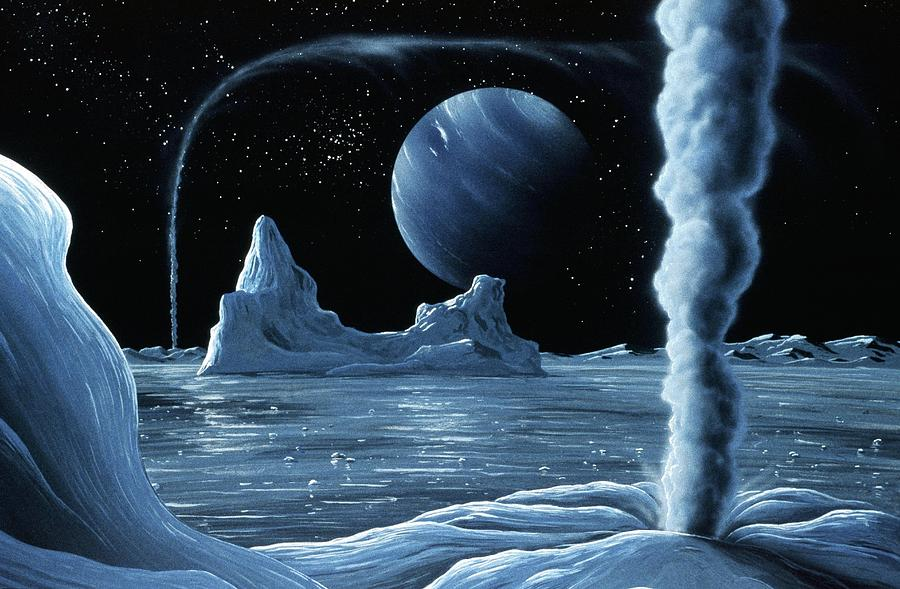
Above: Artist's impression of Triton's cryovolcano. 


Cryovolcanoes or nitrogen smokers on Triton. 

Another thing that causes questions is the mysterious black nitrogen smokers on Triton Moon. There is some kind of ray-shaped energy impact that forms those icy geysers on that icy moon. Could the thing that causes those black geysers be the Einstein-Rose bridge or wormhole that travels through Triton? Conditions on that icy moon should be extremely stable. And the temperature along with gas pressure are very low. So forming the icy geyser requires some kind of energy impact. 

And if that energy impact would be some kind of gravitational effect from Neptune that causes a much larger volcanic phenomenon. The third thing that causes questions is the fresh ice at Pluto's south pole (down in the image). That fresh ice seems like some kind of eruption from under the icy shell of that dwarf planet. What causes that quite large water eruption on that dwarf planet? 

Dwarf planet Pluto in New Horizon's image. You can see white fresh ice at its south pole. The interesting thing is this. The white material seems to travel in two directions. And it is, of course, possible that Charon's moon's gravity causes that thing. But is its gravity strong enough that it causes that effect? And what is another particle flow's, or another effect's source that causes the other route for that Y-shaped ice structure? 


Is there some kind of common mass center between the Sun and Proxima Centauri?


The thing that causes questions about the common mass center between Alpha Centauri and the Sun is Proxima Centauri. Or Alpha Centauri C: which is another name for Proxima. That orbital period is very long, and that could explain why Proxima is so long the closest star to the Sun.  The Proxima system travels around Alpha Centauri in  547000(+6600−4000) years. 

That red dwarf is the third participant in the Alpha Centauri binary star system.  Proxima Centauri orbits Alpha Centauri A and B. And that means it should sometimes turn in the opposite direction from the sun to another side of Alpha Centauri. 

So how long does that star remain as the closest star to our sun? If there is some kind of common mass center between Alpha Centauri and the Sun, that thing causes the situation that Proxima Centauri is always the closest star to our solar system. The only invisible mass center is a black hole. 


https://edition.cnn.com/2021/04/01/world/uranus-xrays-detected-scli-scn-intl/index.html

https://www.go-astronomy.com/planets/neptune-moon-triton.htm

https://www.nasa.gov/image-feature/detecting-x-rays-from-uranus

https://phys.org/news/2019-09-planet-primodial-black-hole.html

https://scitechdaily.com/hyades-star-cluster-revelations-earths-nearest-black-holes-uncovered/

https://en.wikipedia.org/wiki/Cryovolcano

https://en.wikipedia.org/wiki/Proxima_Centauri

Newtonian and Einstein models are still useful tools.

The Einstein and Newtonian gravitational principles are still “hard stuff”. And today, we can say that all gravitational models are suitable...