Showing posts with label WIMP. Show all posts

Wednesday, August 27, 2025

Dark dwarfs can get their energy from dark matter.

    Dark dwarfs can get their energy from dark matter. 


"Mysterious “dark dwarfs” may glow eternally by burning invisible dark matter — and spotting them could finally crack one of the universe’s greatest mysteries. (Artist’s concept.) Credit: SciTechDaily.com"(ScitechDaily, These Stars Don’t Burn – They Annihilate Dark Matter)

Astronomers may have discovered a whole new type of star — mysterious “dark dwarfs” that could glow forever by feeding on dark matter, the invisible substance thought to make up most of the universe. Unlike ordinary stars that burn nuclear fuel, these strange objects might be powered by annihilating dark matter particles, creating an eternal source of light. (ScitechDaily, These Stars Don’t Burn – They Annihilate Dark Matter)

In some hypotheses, Dark matter particle collisions are a dark energy sources. The gravitational center can collect those particles, but the object must have a certain density so that it can bind that dark energy. Another version is that the energy density in dark energy must be high enough. It can interact with visible material. Dark matter has a gravitational interaction. With visible matter. That means the gravity center can collect dark matter into them. And that can make those objects shine. 

And if dark dwarfs or dark stars annihilate dark matter, that means they form dark energy. Or change dark matter particles, hypothetical Weakly Interacting Massive Particles, WIMPs, or axions into dark energy. 

Dark Dwarfs are hypothetical forms of brown dwarfs. That kind of object can pull dark matter inside it. And start to get its energy from hypothetical dark matter particle impacts. There is a possibility that dark dwarfs can get their energy from dark matter. And if those things exist, they can be the eternal glow in the universe. But could those dark dwarves exist forever? That depends on one thing: does dark matter exist, depending on the visible matter, and visible particles? Or is dark matter formed in some independent process? 

Dark dwarfs are things that can form from brown dwarfs. Those brown dwarfs can pull dark matter particles into their core. All known gravitational centers can pull dark matter inside them. But how dense the object must be that it can start to glow because of dark energy. Hypothetical dark matter particles can form dark energy. When they collide with each other. The object must be very dense so that it can harness dark energy. 

Or could dark matter exist even before the visible matter formed in the event, or series of events, called the Big Bang? If dark matter formed in the Big Bang, that means its existence depends on the visible universe. But then, if we think about those hypothetical dark dwarfs, we face a situation where the small brown dwarf can start to pull dark matter particles, hypothetical axions, or WIMPS into its core. There, those WIMPs or axions interact with other WIMPs and axions. 

That causes annihilation or some kind of fusion between those particles. And then that makes those dark dwarves shine. Another question is this: can the dark matter annihilation form dark energy, or could the product of that reaction be the visible energy? That means dark matter fusion. or annihilation or WIMP impacts form dark energy. But then. We can think about cases like black holes. Near black holes, the dark energy density can be high enough. It can start interacting with visible particles or wave movement. 

And maybe dark energy and dark matter give at least part of the black hole’s energy. There is one way to transform dark energy into visible energy, and that method is to create a dark energy soliton. The dark energy soliton would be like all other solitons. It packs wave movement. Into one point. That increases the wave movement energy level and, in the same way, raises the wave height. And that means the dark energy solitons can also interact with their environment. Could some dark matter particles be some kind of solitons?  That explains why we cannot see those objects. 


https://www.durham.ac.uk/news-events/latest-news/2025/07/mysterious-dark-dwarfs-may-be-hiding-at-the-heart-of-the-milky-way/


https://scitechdaily.com/these-stars-dont-burn-they-annihilate-dark-matter/


https://en.wikipedia.org/wiki/Axion


https://en.wikipedia.org/wiki/Weakly_interacting_massive_particle


Friday, August 8, 2025

Radical new theory about dark matter.

   Radical new theory about dark matter.


"An artistic illustration of the mechanism proposed by Professor Stefano Profumo where quantum effects near the rapidly expanding cosmic horizon after the Big Bang gravitationally generate dark matter particles. Credit: Stefano Profumo" (ScitechDaily, Two Wild New Theories Could Finally Explain Dark Matter)

************************************************'

Next quotes are from ScitechDaily

"One idea envisions a hidden “mirror” universe with its own particles and forces, where the early cosmos forged tiny, incredibly dense black hole–like objects that could make up all the dark matter in existence."

"Another proposes that dark matter emerged from the universe’s rapid expansion, born through quantum radiation at the very edge of the observable cosmos during a short but dramatic period after the Big Bang."

"Both possibilities are grounded in established physics, offering testable explanations that carry forward UC Santa Cruz’s tradition of connecting the smallest particles with the largest cosmic mysteries."

(ScitechDaily, Two Wild New Theories Could Finally Explain Dark Matter)

************************************************'

The new radical theory explains dark matter as it formed in the quantum fields in the young universe. Or in some other, even more exciting versions, dark matter formed in the mirror universe.  This new theory tries to explain dark matter as particles that formed just after the Big Bang. Then some of those particles stayed in a higher energy level than other material. 

We must notice that the matter that we can detect is a minority in the universe. The term "dark matter" means a gravitational effect that has no visible source. There is a model of a hypothetical tachyon particle. That which travels faster than light leaves a track or hole behind it. That channel is like a hole or a tunnel in the 3rd. Dimension. And that tunnel makes those fields move like real particles. But in that model, tachyons must exist. 


"Diagram of the Meissner effect. Magnetic field lines, represented as arrows, are excluded from a superconductor when it is below its critical temperature." (Wikipedia, Meissner effect)


In the gravitational model, Tc (temperature critical) is replaced by Mc (Mass critical). There could also be a critical density at which this thing works. So maybe singularity in black holes or energy in the event horizon makes the gravity behave like EM-fields interact with superconducting objects. Maybe that effect in gravitational form requires that the object is surrounded by an absolutely slight quantum gravity bubble that aims gravity waves around the object. In that model, the object has a slight quantum field that cannot catch and hang onto the outside quantum field around it. That makes outside fields slide around the object. 

G-(gravity)field and dark matter. There is a model that G-field or gravity waves can exist without material or other quantum fields. That means there are four fundamental interactions. Those interactions are gravity, electromagnetism, weak nuclear interaction, and strong nuclear interaction. Each of those four interactions has its individual transmitter particle. And those interactions have wave and particle forms. Three of those transmitter particles, bosons, are known. The graviton is missing a transmitter particle.

Each of them can form individual fields. Every single field has individual wavelengths. Wavelength in electromagnetic fields is different from the wavelength in the weak nuclear interaction, for example. All of those fields can exist independently. And that means: gravity- or G-field can exist without other fields. 

There is a model of dark matter that suggests it is the graviton, or an extremely small black hole. The idea is that the particle's spin is very fast. And that can form the effect that looks like a Meissner effect. That spin drives makes electromagnetic fields behave like they behave around the superconducting particle. That thing makes those particles invisible. That means that dark matter is free gravitons. 

Those things are still hypothetical particles. And proving that thing requires that dark matter have a particle form. That means things like axions or weakly interacting massive particles, WIMPs, are the same thing as gravitons. The graviton is a mythical transmitter particle that transmits gravitational waves. That particle is hard to detect. And harder to confirm. The energy flow around that particle allows it to interact. But the interaction point is too small. Or maybe the graviton is like a neutrino, and maybe it can tunnel through matter. 

Another interesting part of the new model is that. The dark matter comes from some kind of anti-universe. There is a possibility that there is a so-called anti-universe. When our universe, or the universe where we live, expands, that anti-universe falls, or reduces. That causes the idea that maybe time travels backward in that anti-universe. But that is one of the models that requires more discussion. 

The thing is that the anti-universe is the place where material turns younger because its energy level rises. Or maybe, we should say that the energy density in the anti-universe causes matter to turn younger. But can the dark matter be material where time moves backward? 

Is it possible that the dark matter is in the bubble, or the so-called WARP bubble, where it gets more energy than it releases? If WIMP or whatever the dark matter particle can be gets more energy than it releases, that means the particle travels opposite in time than all other particles. 


https://scitechdaily.com/two-wild-new-theories-could-finally-explain-dark-matter/


https://en.wikipedia.org/wiki/Dark_matter


https://en.wikipedia.org/wiki/Meissner_effect


https://en.wikipedia.org/wiki/Tachyon


https://en.wikipedia.org/wiki/Weakly_interacting_massive_particle


Sunday, August 13, 2023

What is the nature of dark matter?

Gravitation may interact through dark matter. And that means dark matter or its hypothetical particle WIMP (Weakly Interacting Massive Particle) is the connector between gravitation and visible material. 

We can think that all objects act similarly when they travel through space. When a high-speed object travels in gas, it forms a low-pressure cone behind it. In the same way, when a particle travels in spacetime, there is a similar low-pressure quantum vacuum behind it. 

When particles or objects travel in spacetime. There is always a low-pressure channel behind them. If we think that the gravitational center pulls objects very hard into it through gravitational strings, there is also another quantum cone behind that particle. The graviton that could be an extremely small particle doesn't make exceptions with this thing. 

Graviton itself may be WIMP or the WIMP is the next particle between graviton and maybe gluon. The thing is that WIMP could be the gate to the fourth dimension or energy level, where a particle loses its ability to interact with three-dimensional particles. 


The size of the gravitational string is very small. So there is a model that thing the gravitational string pulls in it is WIMP (Weakly Interacting Massive Particle), or hypothetical dark matter particle. And then the visible material particle follows that dark matter particle in its quantum low-pressure cone. 

When the gravitation is strong enough, the cone behind the object stops it. That freezing happens at the speed of light. So what is the direction in which particles travel? That depends on the symmetry of those low-pressure cones. If those cones are symmetrical or have the same strength, particles cannot move and that field traps them. 

The light cone could also introduce a situation where particles reach the speed of light. The energy that pushes the particle has the same strength as the energy that pushes the particle back. So those energy cones have the same strength. 

So how gravitation can break this model? The idea is that gravitation pulls other particles to the cone behind the particle that falls into the black hole. In that model, the other particles and radiation that come behind the particle mash it through the event horizon. 


The idea is this: gravitation interacts through dark matter. The number of those gravitational strings determines the power of the gravitational field. And in that model gravitons forming in dark matter impacts in the middle of gravitational centers. Maybe the Euclid mission can prove this thing. 

The idea is that gravitation interacts through strings that form behind gravitons. The surface area of those strings where there is an electromagnetic or quantum vacuum is so small that interaction can be seen only in the smallest parts of atoms. When the speed of the particle is high enough, the cone behind it pulls it back. And at the speed of light, the cone behind the particle pulls it back so strongly that it cannot accelerate anymore.

So if we think that gravitation is interacting with dark matter, we might make a model of a graviton. The idea is this: in the center of all gravitational centers is a point where dark matter particles (weakly interacting massive particles, WIMPs) impact.

When a graviton, or hypothetical gravitational transporter, travels out from the gravitational center, it forms the hollow quantum string behind it. That string interacts with dark matter. The idea is that WIMP is a small particle with a large quantum power field. The power field causes small energy asymmetries in particles.

And then they fall into the gravitational field, which is a group of hollow strings. Those strings are like tubes where there is quantum or electromagnetic low pressure. When visible matter starts to fall into those stirrings, that matter acts like a plug. There is low electromagnetic pressure in that string that pulls particles to the gravitational center.


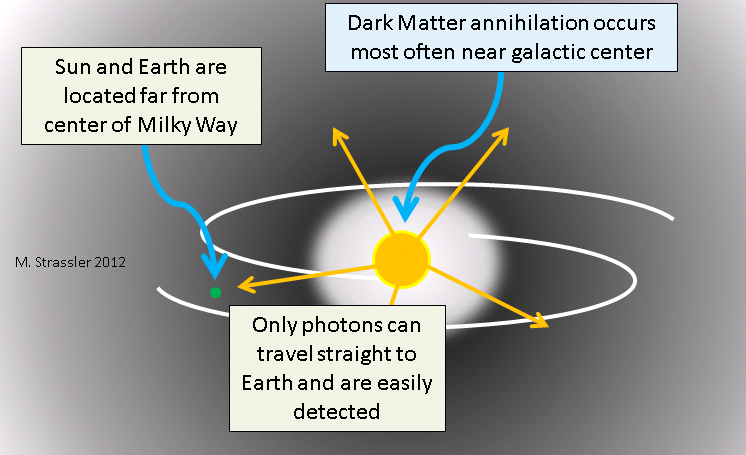
Dark matter annihilation happens in all gravitational centers. The strength of that phenomenon depends on the strength of gravitation. And the number of gravitational stríngs determines the power of gravitation. 


There are two ways this could happen.


1) The WIMP travels at the front of the particle. That means the graviton channel pulls WIMP into the gravitational center. And visible material particles are traveling behind the WIMP and its quantum low-pressure channel.

2) The WIMPs impact visible particles in the quantum field opposite the gravitational center. That causes energy asymmetries where electromagnetic low-pressure forms on the particle's front side. That thing could explain the gravitational interaction.


The particle where WIMPs touch could be a gluon or a string between gluons and quarks.


Dark matter's annihilation forms gravitons. So graviton is the particle that is the result of those dark matter impacts. The idea is that when WIMPs impact, they send graviton particles around those impacts. When hypothetical gravitons travel through spacetime there is a quantum tunnel behind them. That tunnel or string pulls those particles back into the gravitational center. Even if gravitons are small particles they still interact like all other particles. 

When the graviton starts to fall, it takes WIMP particles with it. The WIMP is such a small particle that its interaction is hard to notice, and maybe that interaction where gravitons, as well as WIMPs, interact with visible matter is the gluon or string between gluons and quarks. The WIMP interacts like a hook that pulls the smallest parts of matter into the middle of the gravitational centers.


https://www.nasa.gov/image-feature/shining-a-light-on-dark-matter

https://phys.org/news/2023-08-astronomers-dark-annihilation-center-earth.html

https://profmattstrassler.com/articles-and-posts/relativity-space-astronomy-and-cosmology/dark-matter/dark-matter-annihilation/

https://en.wikipedia.org/wiki/Dark_matter

https://en.wikipedia.org/wiki/Modified_Newtonian_dynamics

https://en.wikipedia.org/wiki/Weakly_interacting_massive_particle

Image 2) https://profmattstrassler.com/articles-and-posts/relativity-space-astronomy-and-cosmology/dark-matter/dark-matter-annihilation/

Could a graviton be a low-energy photon?

Image of a photon. We can think of gravity as forming when particles or objects spin. That spin binds energy from around it. That spin turns...