Showing posts with label trajectories. Show all posts

Friday, August 1, 2025

Can the quantum Coriolis force make quantum mechanics warp around the gravity centers?


"A new study reveals that even small differences in elevation between quantum computers—just one kilometer apart—can allow Earth’s gravity to measurably affect quantum systems, challenging one of the foundational principles of quantum mechanics. Credit: SciTechDaily.com". (ScitechDaily, Earth’s Gravity Might Be Warping Quantum Mechanics, Say Physicists)

The fact is that we think that gravity centers are in the middle of the whirls of the quantum fields. The strength of those whirls depends on the density and mass of the gravity centers. The most powerful whirls are around black holes. But the fact is that all gravity fields, including planets, form those whirls. The size of the whirl depends on the turbulence around the object. And the mass of the object can also determine how powerful that whirl can be. In the same way, when a particle spins, it stores energy into itself. If a spinning particle is in the quantum field, it causes an anomaly or asymmetry in the quantum field around the particle. 

The fact is that we think that gravity centers are in the middle of the whirls of the quantum fields. The strength of those whirls depends on the density and mass of the gravity centers. The most powerful whirls are around black holes. But the fact is that all gravity fields, including planets, form those whirls. The size of the whirl depends on the turbulence around the object. And the mass of the object can also determine how powerful that whirl can be. 

In an absolutely stable space, the interference is low, and even low-mass objects can form black holes if they can pull enough gas around them. If nothing disturbs, that gas can form a black hole. But near stars like the sun, the stars cause interference that destroys those structures. Every whirl disturbs their environment. And there is a thing on the surfaces of every spinning object. That means the quantum fields that whirl around the gravitational centers can form a quantum version of the Coriolis force. 


"The Earth’s gravity, manifested as curvature in space and time, is expected to alter the rules of standard quantum theory. An experiment consisting of three quantum computers at different elevations can reveal the interplay between gravity and quantum mechanics. Credit: The Grainger College of Engineering at the University of Illinois Urbana-Champaign"


"In the inertial frame of reference (upper part of the picture), the black ball moves in a straight line. However, the observer (red dot) who is standing in the rotating/non-inertial frame of reference (lower part of the picture) sees the object as following a curved path due to the Coriolis and centrifugal forces present in this frame." (Wikipedia, Coriolis force)

So that means all particles and objects near the gravity center, including Earth, can be in the whirl where the Coriolis force makes them spin. The Coriolis force is a fictitious force that makes anomalies in particle tracks. The coriolis force can be introduced when the particle hovers above the object, and then the object spins under it. That causes the particle to rotate against the larger object’s rotational direction. That means the Coriolis force can also exist in rotating fields. That force might be very weak. 

But in extreme conditions like over galaxy-size structures, that force turns stronger. And in other ways, we can think that the single particles are very light. That means a weak effect can interact with them and change their trajectories. Maybe anomalies in a single particle’s trajectory don’t mean much in large-scale systems. But in the quantum-scale systems, the field-based Coriolis force can cause particles to follow unexpected trajectories that are like screws. 


https://scitechdaily.com/earths-gravity-might-be-warping-quantum-mechanics-say-physicists/

https://en.wikipedia.org/wiki/Coriolis_force

Friday, March 4, 2022

Does the gluon or gluons orbit quarks "8"-shaped or regular orbiting trajectory?

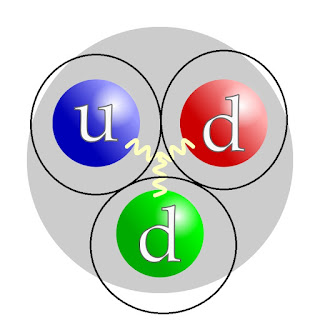
Above this text is an image of neutron (Image 1). The effect of the strong interaction strong nuclear force marked as a "Y"-shaped structure. But what is the thing that makes those quarks stay in one entirety? The  2 down quarks and 1 up quarks. Along with gluons, those quarks form neutrons. 2 Up quarks and 1 down quark with gluons form protons. The gluons connecting those particles to their entirety are called neutrons or protons. 

The strong interaction is not the interaction between quarks. It is the interaction between quarks and gluons. But why gluons are keeping the neutrons and protons as one entirety. There is the possibility that the gluon is orbiting quarks by the eight-shaped trajectory. And that thing means that the pressure of that particle is pushing the quarks to one entirety. Those trajectories are drawn in image 2 by using black circles. (Image 2)

When we are thinking about image 2. There are marked possible trajectories of gluons. The trajectories could be "8"-shaped. But gluons can also orbit those quarks with regular orbiting trajectories. That causes an idea that could there be the forms that we can call "atoms in atoms". So could some elementary particle be the "miniature atom"? 

Why do I think like this? The reason for that is that. If the gluons are moving or jumping between those quarks. That could destroy the proton or neuron. So there must be some kind of electromagnetic vacuum in the middle of those quarks. Or the gluons would orbit around those quarks that cause their quantum fields are pushing quarks together. 


Image 2: 


Explanation 2. 

Could the mysterious graviton be the particle in the middle of the proton or neutron? The theory is that graviton could just be the quantum-size black hole. 

About the question of why protons and neutrons are in their form? In that case. The quantum-size black hole or hypothetical graviton pulls superstrings from quarks inside it. That thing causes the radiation that is called dark energy and the expansion of the universe. 

But that requires that graviton exists. The hypothetical quantum-size black holes are acting just like large black holes. When they are pulling something inside them. That thing causes radiation. So could the graviton be the quantum-size black hole?

But there can be some other interesting explanation for that thing. And that thing is the most fascinating in the world. Maybe there is graviton in the middle of protons or neutrons. That thing means that the graviton could be a quantum-size black hole. That pulls the strings from the quarks inside it. 

Because energy or superstrings are traveling only in one direction. That is in the middle of the quarks that cause the recoil effect. The recoil effect keeps those quarks at a certain distance from the center of the particle. And the balance between the pushing and pulling effect keeps those quarks in one entirety. 

But if quarks are like small yarn balls they are losing their mass all the time when that quantum-size black hole will pull those superstrings in it. And that causes the radiation. 


https://en.wikipedia.org/wiki/Gluon


https://en.wikipedia.org/wiki/Graviton


https://en.wikipedia.org/wiki/Neutron


https://en.wikipedia.org/wiki/Proton


https://en.wikipedia.org/wiki/Quark


https://en.wikipedia.org/wiki/Standard_Model


https://en.wikipedia.org/wiki/Strong_interaction

Black holes don’t make information vanish. They just. Transform it into another form.

“Even in the complete absence of external matter, black holes aren’t completely dark, as a very small amount of low-energy radiation gets em...